
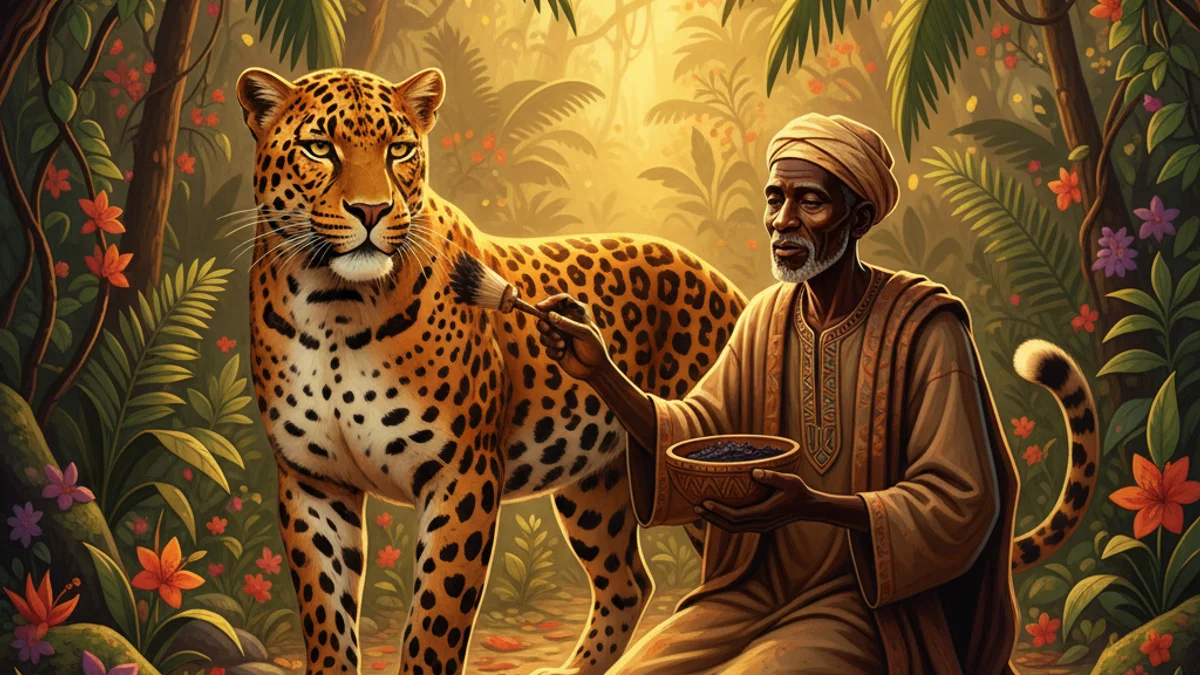
Long ago, Osebo the Leopard had a coat as plain as the golden desert sand. While he was a powerful and swift hunter, his bright, solid fur made him easy to spot against the deep greens and shifting shadows of the Ashanti forest. One day, Osebo came across an old medicine man who had fallen into a deep pit. Using his great strength, the leopard pulled the man to safety. In gratitude, the medicine man offered Osebo a gift that would make him the ultimate hunter. He mixed a magical black dye from crushed seed pods and charred wood. With his fingertips, the man pressed dark, circular rosettes into Osebo's fur, mimicking the patterns of sunlight filtering through the jungle canopy. 'Now,' the man whispered, 'the shadows will be your cloak.' From that day on, Osebo wore his spots as a mark of his service and a tool for his survival, disappearing perfectly into the dappled light of the forest floor.
Adaptability and the ability to blend in are often more valuable than being noticed.
Questions about this story
What is the moral of The Leopard's Spots?
The moral of the story is that adaptation and stealth are essential qualities for survival. It teaches that unique traits often serve a practical purpose in helping one navigate their environment effectively.
Who is Osebo in Ashanti folklore?
Osebo is the name for the leopard in Akan and Ashanti mythology. He is often depicted as a powerful, fierce, and regal character who frequently interacts with Anansi the Spider.
How did the leopard get his spots in this version of the story?
In this Ashanti tale, the leopard is rewarded by a medicine man for his kindness. The man uses a magical black dye to paint spots on the leopard, allowing him to camouflage in the forest shadows.
Is The Leopard's Spots the same as Rudyard Kipling's version?
While the theme of receiving spots for camouflage is similar, the Ashanti version focuses on West African settings and often involves themes of mutual respect or rewards for service, differing from Kipling's 'Just So Stories'.
Advertisement


Good night.
