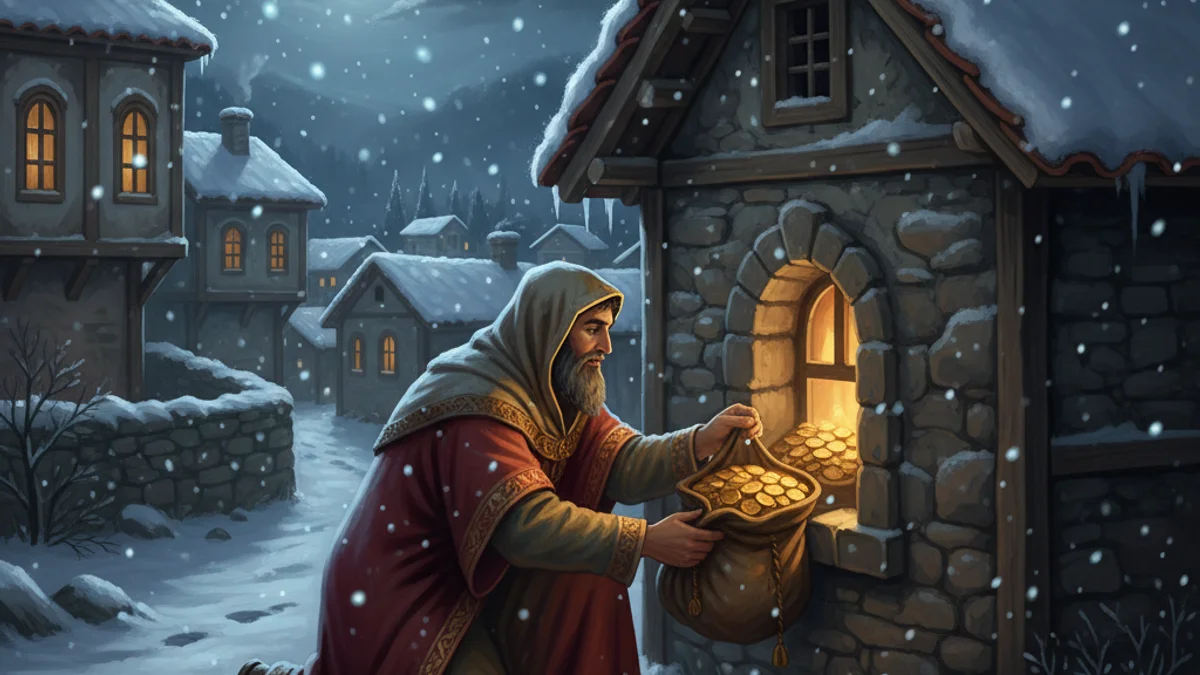
In the 4th century, in the ancient town of Myra, lived a devout bishop named Nicholas. Born to wealthy parents who passed away while he was young, Nicholas chose to use his entire inheritance to help the suffering and the poor. His most famous legend involves a desperate father of three daughters who could not afford their dowries, facing a future of ruin. Under the cover of darkness, Nicholas crept to the man's window and tossed a bag of gold inside, providing for the eldest daughter. He returned a second night for the middle daughter. On the third night, the father kept watch and caught the bishop, but Nicholas begged him to keep the secret of his identity. Over time, stories of his quiet charity spread across the world. His legacy of secret gift-giving transformed through the centuries, evolving from the historical Bishop of Myra into the beloved figure of Santa Claus.
True generosity is most powerful when it is done selflessly and without the desire for recognition.
Advertisement
Questions about this story
What is the moral of The Legend of Saint Nicholas?
The moral is that true charity is found in giving without seeking credit. It emphasizes compassion and the importance of helping those in need discreetly and selflessly.
Who was the real Saint Nicholas?
The real Saint Nicholas was a 4th-century Greek Bishop of Myra, located in modern-day Turkey. He was famous for his piety and his many acts of kindness toward the poor and children.
How did Saint Nicholas become Santa Claus?
The name 'Santa Claus' evolved from 'Sinterklaas,' which is the Dutch name for Saint Nicholas. Dutch immigrants brought these traditions to America, where the character eventually merged with English folklore.
What is the story of the gold in the stockings?
In some versions of the legend, Nicholas dropped gold through a chimney and it landed in stockings hanging by the fire to dry. This started the tradition of hanging stockings for Christmas gifts.
Advertisement