
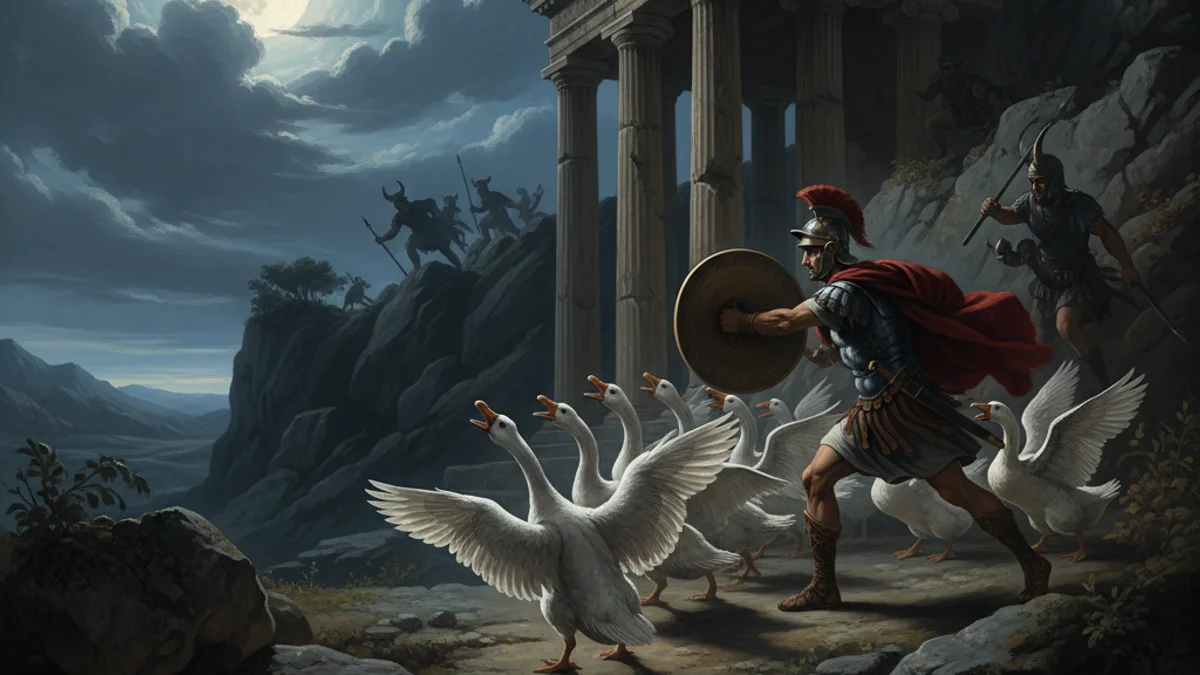
In 390 BC, Rome faced its darkest hour as the Gauls, led by the fierce Brennus, sacked the city. The remaining Roman defenders retreated to the steep cliffs of the Capitoline Hill, holding out against a grueling siege. One moonless night, the Gauls discovered a hidden path up the rugged rocks. Moving with ghost-like silence, they bypassed the exhausted sentries and even the watchful guard dogs, who remained fast asleep. However, near the Temple of Juno lived a flock of sacred geese, kept even during the famine out of respect for the goddess. As the first Gaul reached the summit, the sensitive geese began to hiss and flap their wings frantically. The clamor awakened Marcus Manlius, a former consul, who rushed to the ramparts and pushed the lead invader off the cliff. The alarm spread, the Roman garrison rallied, and the surprise attack was repelled. Rome was saved not by its legionaries or its dogs, but by the vigilant honking of Juno's sacred birds.
Vigilance is the price of liberty, and even the smallest, most unexpected creatures can play a vital role in a nation's destiny.
Questions about this story
What is the moral of The Geese that Saved Rome?
The story teaches that vigilance is essential for safety and that no contribution is too small. It also emphasizes the importance of honoring the divine, as the sacred geese provided the warning humans missed.
Who was the Roman hero that responded to the geese?
Marcus Manlius, later surnamed Capitolinus, was the Roman soldier who first heard the geese. He single-handedly held off the initial Gaulish climbers until the rest of the garrison could be awakened.
Why were there geese on the Capitoline Hill?
The geese were sacred to the goddess Juno and lived within the precincts of her temple. Despite the severe food shortages during the siege, the Romans refused to eat them out of religious devotion.
Is the story of the geese saving Rome historically true?
While the Sack of Rome by the Gauls around 390 BC is a factual historical event, the story of the geese contains legendary elements. It became a core part of Roman identity and national pride.
Advertisement


Good night.
