
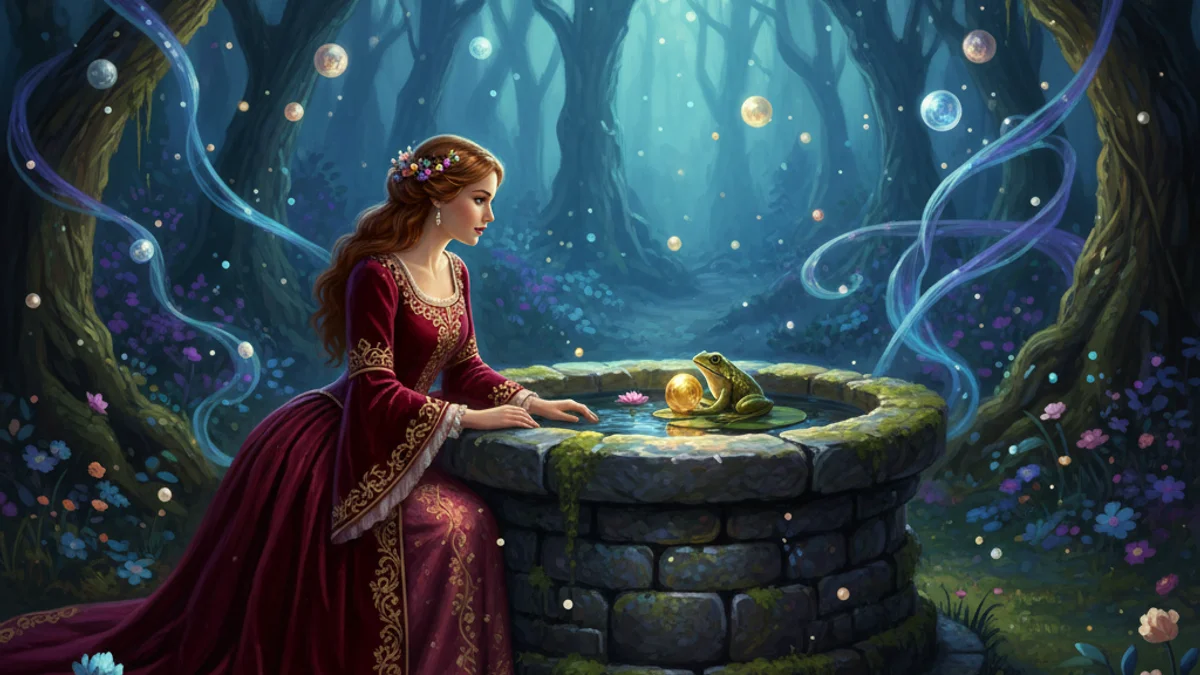
Once, a princess dropped her favorite golden ball into a deep, cool well. A frog surfaced and offered to retrieve it, but only if she promised he could live with her, eat from her golden plate, and sleep in her bed. Desperate to have her toy back, she agreed, though she had no intention of keeping her word. Once the frog returned the ball, she ran back to the palace, leaving him behind. The next day, the frog arrived at the palace gates. Upon hearing the story, the King commanded his daughter to honor her promise. Reluctantly, she let the frog eat from her plate and carry him to her chamber. In the original tale, her frustration peaked and she threw the frog against the wall; in later versions, a kiss breaks the charm. Regardless, the frog was instantly transformed into a handsome prince. He explained he had been under a wicked spell, and the princess's actions—however reluctant—had finally freed him. The two were married and lived happily ever after.
One must keep their promises and look beyond outward appearances to find the true character within.
Questions about this story
What is the moral of The Frog Prince?
The primary moral is to honor your promises, no matter how inconvenient they become. It also teaches that true character and beauty can be found in the most unexpected or unattractive forms.
How did the frog turn back into a prince?
In the popular modern version, a kiss breaks the spell. However, in the Brothers Grimm original, the princess throws the frog against a wall in anger, which triggers his transformation back into a prince.
Who wrote the original Frog Prince story?
The story was famously recorded by the Brothers Grimm in their 1812 collection, Children's and Household Tales. It is officially titled The Frog King, or Iron Henry.
What does the golden ball symbolize?
The golden ball often symbolizes the princess's innocence and her sheltered, perfect world. Losing it in the dark well represents a transition into adulthood where she must face responsibilities and consequences.
Advertisement

Good night.
