
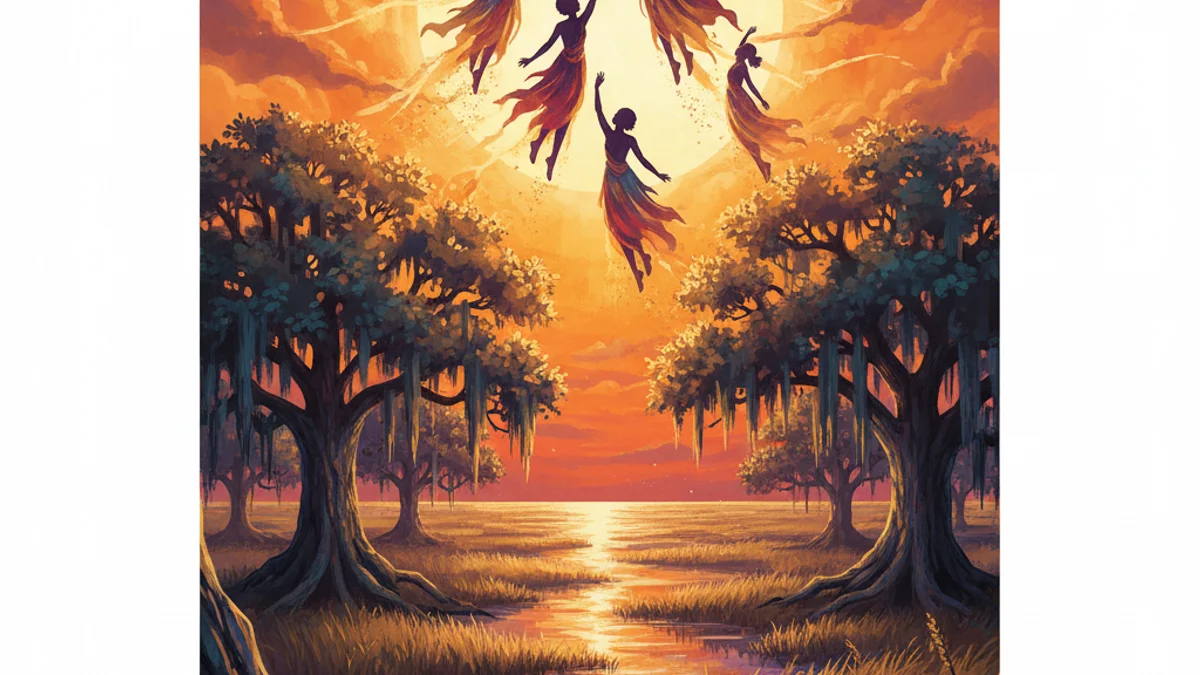
Long ago, on the Sea Islands off the Georgia coast, a group of Igbo people were brought across the ocean in the hulls of ships. Among them was an elder, a man who remembered the secret words of his ancestors. Life under the whip was a weight they could not bear. One day, as the sun hung low and heavy over the marshlands, the elder looked at his brothers and sisters and saw their spirits breaking. He began to chant a rhythm older than the trees, a melody that vibrated through the salt air. One by one, the people joined the song, their feet beginning to lift from the dusty earth. As the overseer shouted and lashed his whip, the Africans did not run; they rose. Their arms stretched wide, catching the Atlantic breeze, and their tattered clothes transformed into shimmering wings. They ascended above the moss-draped live oaks and the crashing surf, soaring westward back across the great waters toward the shores of Africa. They left behind only the memory of their flight and the hope that the soul can never truly be caged.
The human spirit possesses an innate power to transcend physical bondage and reclaim its freedom through cultural memory and faith.
Questions about this story
What is the moral of The Flying Africans (Extended)?
The moral is that the soul and spirit are inherently free and cannot be permanently shackled by physical oppression. It emphasizes the power of collective memory and cultural identity as tools for liberation.
Is The Flying Africans based on a true story?
Yes, it is rooted in the historical event of 1803 at Ibo Landing on St. Simons Island, Georgia, where a group of Igbo captives chose to walk into the water rather than submit to slavery.
Who are the Igbo people mentioned in the tale?
The Igbo are an ethnic group from present-day Nigeria. In the context of this legend, they represent the strength and resistance of West Africans brought to the Americas.
What does the ability to fly symbolize in Gullah folklore?
Flight symbolizes the reclamation of agency, the return to one's roots, and the ultimate escape from the physical suffering of the plantation system.
Advertisement

Good night.
