
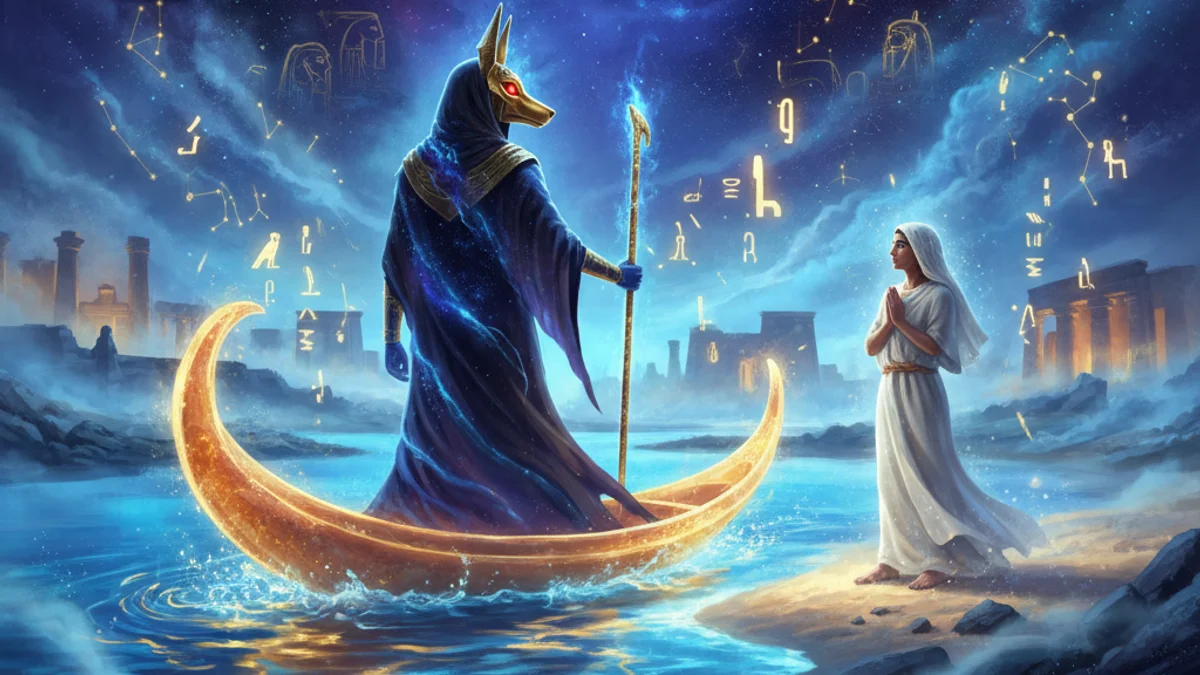
In the shadow-drenched realm of the Duat, a soul approached the celestial river, seeking the lush pastures of the Field of Reeds. There stood Mahaf, the divine ferryman known as 'He-Who-Looks-Behind.' His boat was silent, tethered to the banks of eternity. Before the soul could board, Mahaf issued a challenge: 'You shall not cross unless you can name me and the parts of my vessel.' The deceased, prepared by the sacred scrolls, spoke clearly. They named the oars as the fingers of Horus, the mast as the spine of Osiris, and the hull as the ribs of Isis. Each component was a god, each rope a divine decree. Impressed by this sacred knowledge and the soul's purity of heart, Mahaf turned his gaze and allowed the petitioner to board, rowing them across the dark waters toward the eternal sunrise of Aaru.
Preparedness and the acquisition of sacred knowledge are the keys to overcoming the obstacles of the afterlife.
Questions about this story
What is the moral of The Ferryman's Questions?
The story teaches that spiritual preparation and knowledge are essential for the soul's journey. It emphasizes that entry into paradise is earned through wisdom and the study of divine truths.
Who is the ferryman in Egyptian mythology?
The ferryman is usually identified as Mahaf or Hraf-he, whose name means 'He-Who-Looks-Behind.' He serves as the gatekeeper who transports worthy souls across the celestial waters to Aaru.
What happens during the ferryman's interrogation?
The soul must correctly identify every part of the boat, from the oars to the mast, by their secret divine names. This proves the soul has been properly initiated and possesses the required spiritual insight.
Where is this story recorded in ancient texts?
This trial is primarily found in the 'Book of the Dead,' specifically within Spell 99. It was intended to provide the deceased with the necessary answers to bypass the ferryman's challenge.
Advertisement
Good night.
