
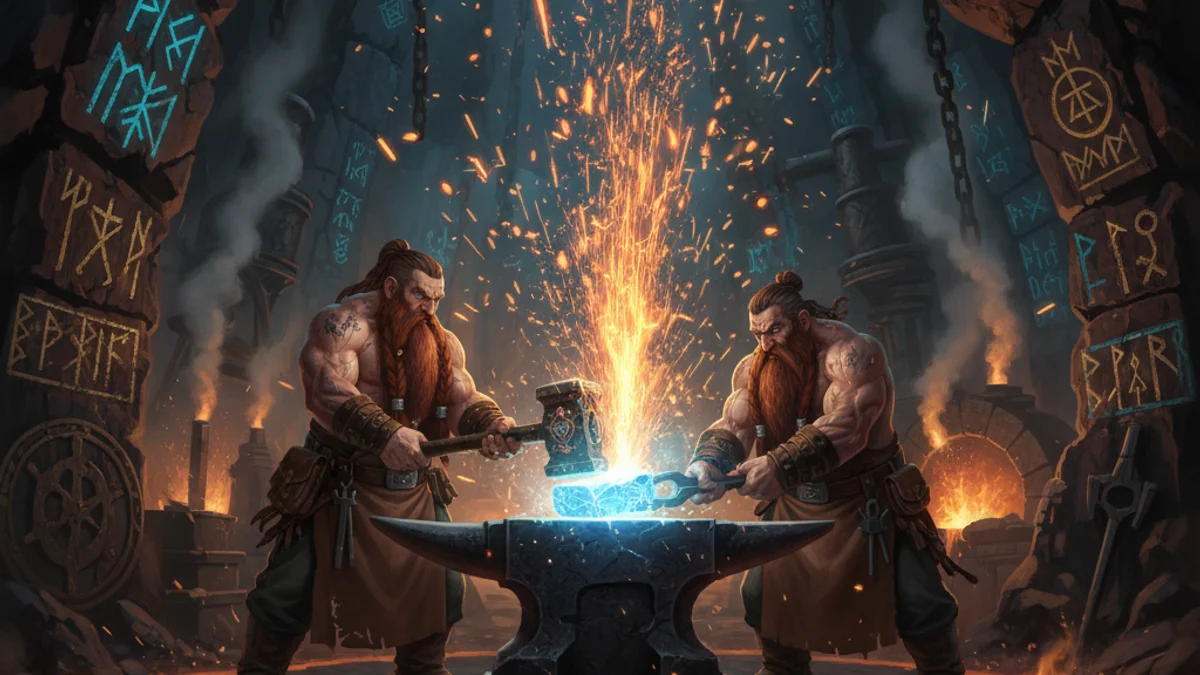
In the beginning, when the world was fashioned from the corpse of the primordial giant Ymir, the gods noticed small creatures crawling like maggots within the giant's flesh. Seeing potential in these beings, the gods granted them human understanding and shapes. These were the Dwarves, master craftsmen of the subterranean realm of Svartalfheim. Living deep within the earth and mountains, they avoided the sun, which could turn them to stone. They became the ultimate smiths, channeling the raw minerals of the earth into objects of impossible power. It was the Dwarves who forged Odin’s spear Gungnir, the golden hair of Sif, and the mighty hammer Mjolnir. Though often characterized by their greed and solitary nature, the cosmos of the Norse gods would have remained powerless without the intricate skill and tireless labor of the dwarven masters at their anvils.
True mastery and value come from dedicated labor and skill, though one must guard against the isolation of greed.
Questions about this story
What is the moral of The Dwarves?
The story emphasizes that great power is often born from hard work and specialized skill. It also warns that while craftsmanship brings prestige, an obsession with material wealth can lead to a secluded and suspicious life.
How were the dwarves created in Norse mythology?
According to the Prose Edda, the dwarves were originally maggot-like creatures that grew in the flesh of the fallen giant Ymir. The gods gave them human likeness and intelligence, assigning them to live beneath the earth.
What did the dwarves forge for the Norse gods?
They forged many of the most famous mythological treasures, including Thor's hammer Mjolnir, Odin's self-multiplying ring Draupnir, and Frey's mechanical boar Gullinbursti. Their smithing was so advanced it was considered magical.
Where do the dwarves live in the Nine Realms?
The dwarves reside in Svartalfheim, sometimes referred to as Nidavellir. It is a dark, underground realm filled with complex mines and magnificent forges located deep within the roots of the world tree, Yggdrasil.
Advertisement
Teach next
Good night.
