Story Summary
Explore the legend of The Dagda's Cauldron, one of the Four Treasures of Ireland. This magical vessel ensured that no guest ever left the All-Father hungry.
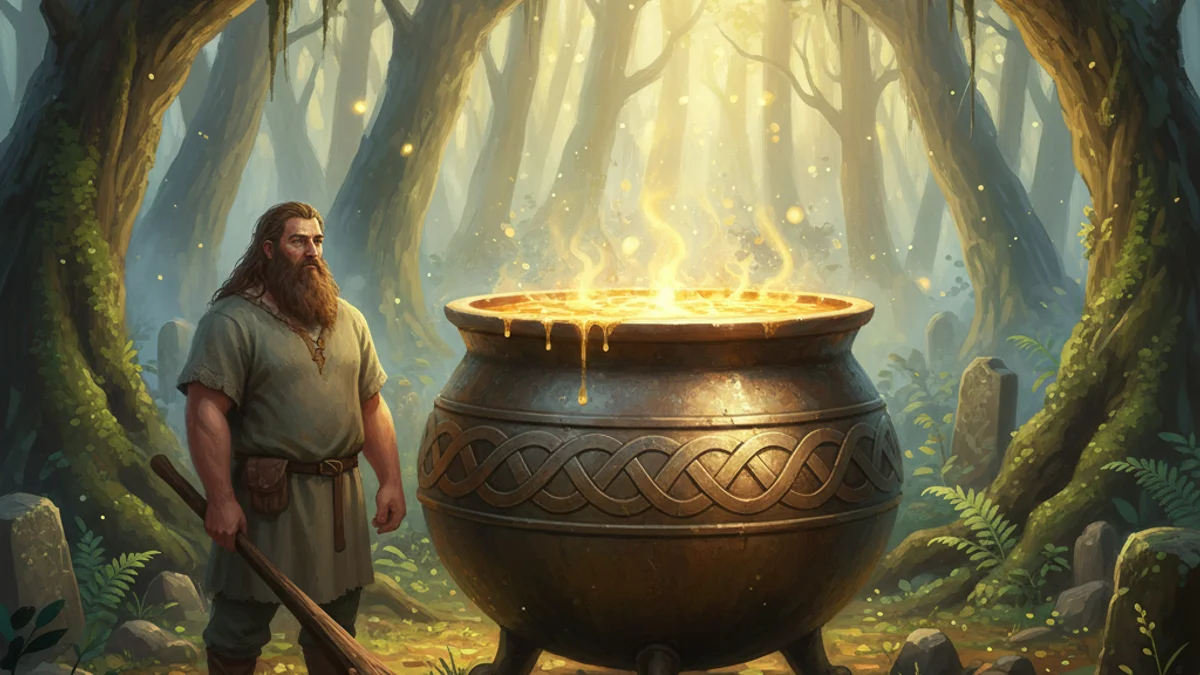
The Dagda, the 'Good God' of the Tuatha Dé Danann, was a figure of immense power and earthiness. Among his most prized possessions was a magical vessel known as the Coire Ansic, or the Undry Cauldron. Brought from the mystical city of Murias, it was one of the four great treasures of Ireland. Unlike ordinary pots, this massive bronze cauldron possessed a miraculous property: no matter how many sat at his table, it never ran dry. It was said that no company ever left it unsatisfied, and it had the power to provide sustenance that matched the spirit of the guest. To the ancient Irish, the cauldron represented the Dagda’s role as the All-Father—a provider who ensured that his people were fed, united, and sustained by the literal and spiritual bounty of the earth. Even in times of war, the cauldron remained a symbol of peace and hospitality, reminding all that the greatest power of a god was the ability to nourish life.
The Moral
The greatest form of power is the ability to provide for others and ensure that no one goes hungry or unsatisfied.
“No company ever went away from it unsatisfied.”
Fun Fact
The Dagda's Cauldron is frequently cited by scholars as a primary mythological precursor to the Holy Grail in later Arthurian legends.
Frequently Asked Questions
What is the moral of The Dagda's Cauldron?
The moral emphasizes the importance of hospitality and the responsibility of those in power to provide for their community. It teaches that true abundance is found in generosity and ensuring that no one is left behind or unsatisfied.
What are the Four Treasures of Ireland?
The Four Treasures are magical artifacts brought to Ireland by the Tuatha Dé Danann: the Spear of Lugh, the Sword of Nuada, the Stone of Destiny (Lia Fáil), and the Dagda's Cauldron.
Who was the Dagda in Irish mythology?
The Dagda is a father-figure deity known as the 'Good God.' He is associated with fertility, agriculture, strength, and magic, often depicted as a powerful man carrying a massive club and a magical cauldron.
What special powers did the cauldron possess?
The cauldron was known as 'The Undry' because it never ran out of food. It had the magical ability to satisfy any number of people, ensuring that no company ever left the Dagda's presence hungry.
Where did the Dagda's Cauldron come from?
According to myth, the cauldron was brought from Murias, one of the four legendary northern cities where the Tuatha Dé Danann learned their wisdom and magic before coming to Ireland.
What does the cauldron symbolize in Celtic culture?
The cauldron symbolizes life, abundance, and the regenerative power of the earth. It represents the chieftain's duty to provide hospitality and the communal bond shared through the act of eating together.
Discussion (0)
Share your thoughts on this story
No comments yet. Be the first to share your thoughts!