
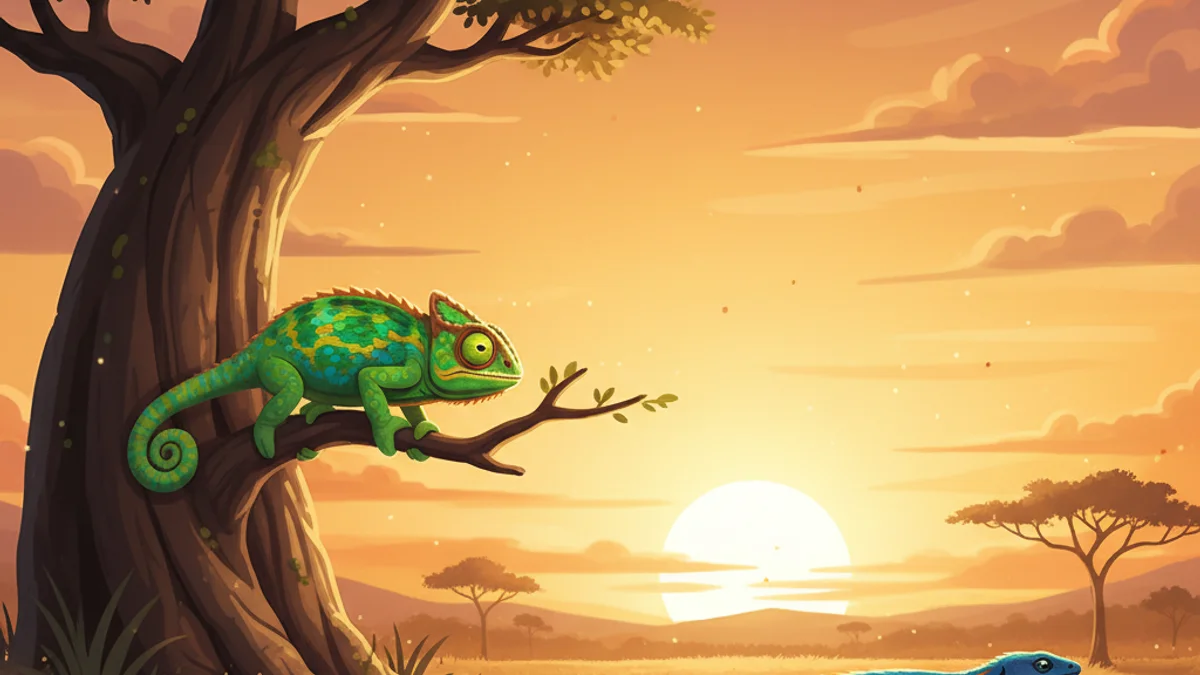
In the beginning, Unkulunkulu, the Great Spirit, decided that humans should live forever. He summoned the slow-moving Chameleon and gave him a sacred message for humanity: 'Men shall not die.' The Chameleon set off, but he was easily distracted. He stopped to eat purple berries and rested in the warm sun, moving with his characteristic, swaying caution. Growing impatient with the delay, or perhaps reconsidering the balance of the world, Unkulunkulu summoned the swift Lizard and gave him a different message: 'Men shall die.' The Lizard sped across the earth, his belly skimming the dust, reaching the first humans long before the Chameleon. He delivered his grim news, and the people accepted the reality of mortality. When the weary Chameleon finally arrived and announced the promise of eternal life, the people shook their heads. 'We have already accepted the word of the Lizard,' they told him. Since that day, death has remained an inescapable part of the human journey.
Procrastination and delay in fulfilling one's duty can lead to irreversible consequences for others.
Questions about this story
What is the moral of The Chameleon and the Lizard?
The moral is that delay and lack of focus can have permanent, negative consequences. It serves as a warning against procrastination when performing important tasks for the community.
Who is Unkulunkulu in the story?
Unkulunkulu is the supreme creator deity in Zulu mythology. He is often depicted as the one who brought forth all things and sent the messengers to define human fate.
Why did the Chameleon take so long to deliver the message?
The Chameleon was naturally slow and became distracted by eating berries and resting. His lack of urgency allowed the swifter Lizard to reach the people first.
What does this story explain in African culture?
This is an aetiological myth, which means it explains the origin of something. In this case, it explains why death exists and why humans are not immortal.
Advertisement


Good night.
