
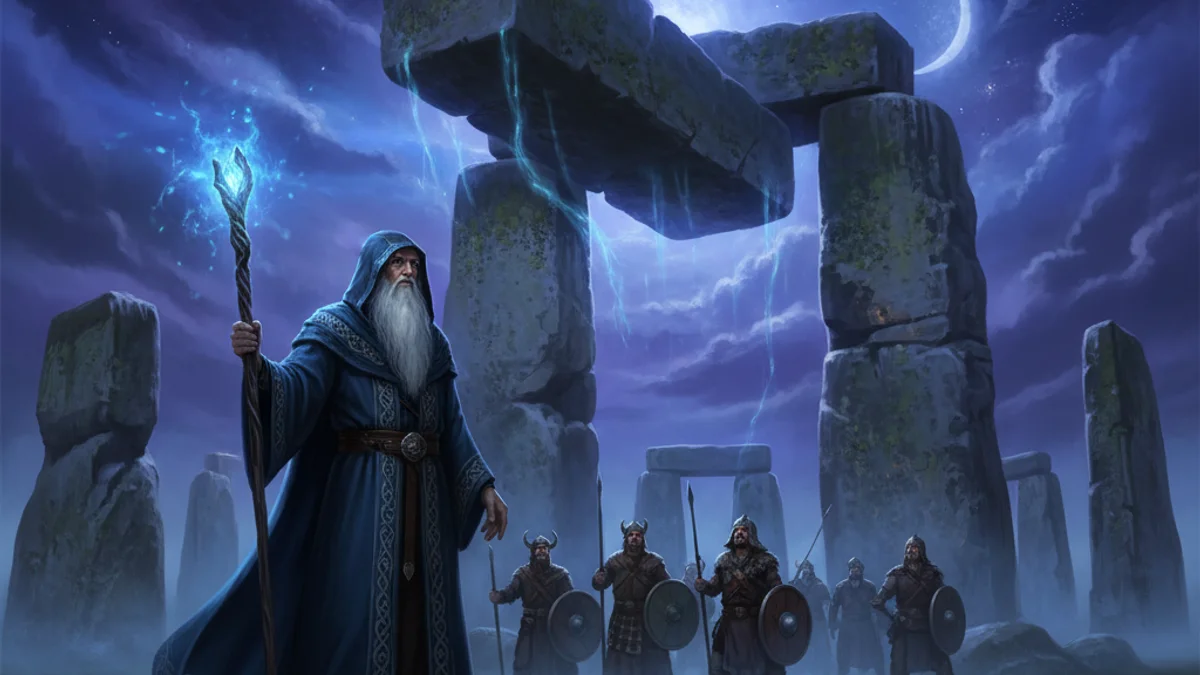
After the treachery of the Night of the Long Knives, where hundreds of British nobles were slaughtered by the Saxons, King Aurelius Ambrosius sought to create a lasting monument to honor the fallen. He summoned the great wizard Merlin, who suggested the Giant’s Dance, a circle of mystical stones located on Mount Killaraus in Ireland. The king sent an army led by Uther Pendragon to retrieve them, but the soldiers found the stones impossible to move through sheer brawn. Merlin laughed at their struggle, asserting that wit is often stronger than muscle. Using his secret arts and ingenious machinery, Merlin dismantled the stones with ease. He transported them across the sea to the Salisbury Plain. There, he re-erected the massive pillars in their original circular formation, creating the monument known as Stonehenge. It remains a testament to the fallen heroes and a symbol of Merlin’s incomparable wisdom.
True power resides in wisdom and ingenuity rather than raw physical strength.
Questions about this story
What is the moral of Stonehenge?
The story teaches that intellectual craft and ingenuity can overcome physical challenges that brute force cannot. It emphasizes that the mind is a more powerful tool than the sword.
How did Merlin move the stones according to legend?
Legend says Merlin used a combination of magic and sophisticated mechanical 'engines' to dismantle and transport the stones. He famously claimed that his 'art' was superior to the strength of fifteen thousand men.
Why did King Aurelius want to build the monument?
The King wanted to create a permanent memorial for the British nobles who were treacherously murdered by the Saxons during a peace treaty. It was intended to be a site of eternal honor and remembrance.
Where did the legendary stones originally come from?
According to the Arthurian legend recorded by Geoffrey of Monmouth, the stones were originally the 'Giant's Dance' located in Ireland. They were believed to have been brought to Ireland by giants from Africa for their healing properties.
Advertisement
Good night.
