
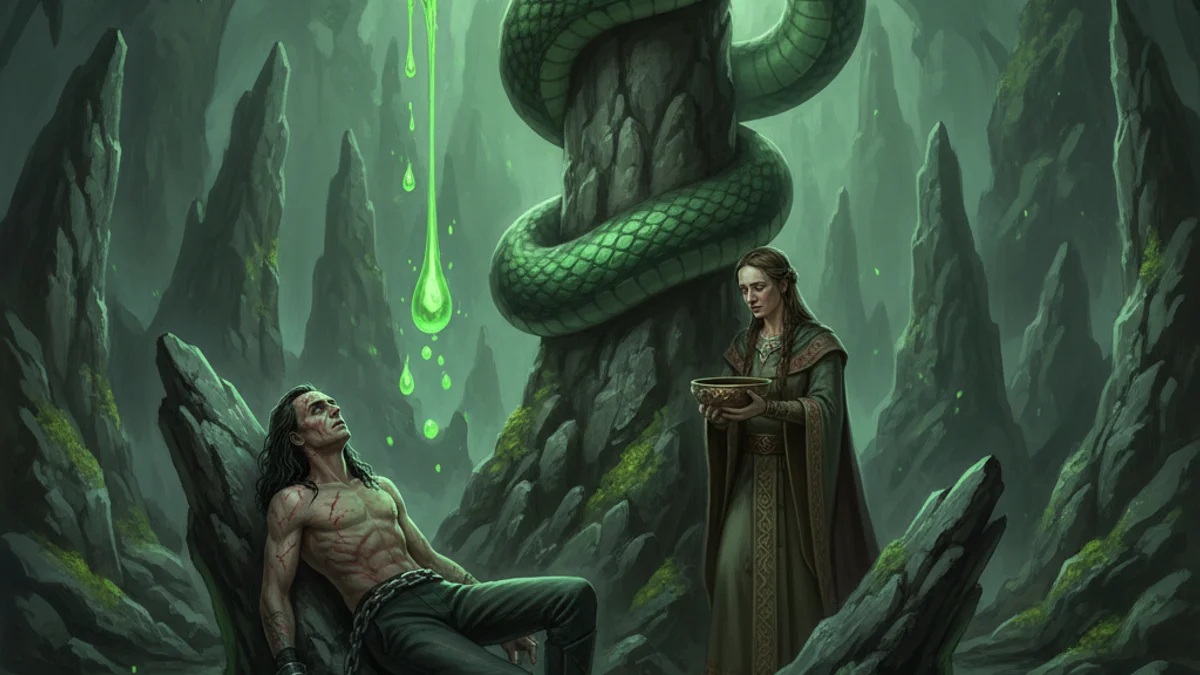
After the trickster Loki orchestrated the death of the beloved god Baldur, the Aesir sought a punishment equal to his crime. They pursued him to a dark, damp cavern deep within the earth. There, they bound Loki to three jagged rocks using the cold, unbreakable entrails of his own son. To ensure his suffering, the goddess Skadi fastened a venomous serpent above him, positioned so its burning poison would drip directly onto his face. While the gods and the world turned away in loathing, Loki’s wife, Sigyn, refused to abandon him. She stood by his side, holding a bronze bowl to catch the caustic venom before it could touch his skin. For eons, she remained in the shadows, her arms aching and her heart heavy with sorrow. Only when the bowl reached its brim would she step away to empty it. In those brief moments, the venom splashed onto Loki’s flesh, and his screams of agony were so violent that they shook the foundations of the world, creating the earthquakes felt by mortals. Through her silent, eternal vigil, Sigyn became the ultimate symbol of enduring and selfless devotion.
True loyalty is not measured in times of prosperity, but in the depth of one's devotion during the darkest and most difficult trials.
Questions about this story
What is the moral of Sigyn and Loki?
The story highlights the power of unwavering loyalty and unconditional love. Even when a partner has committed great wrongs, Sigyn's devotion remains a testament to the strength of the marital bond against all odds.
Why was Loki punished by the gods?
Loki was punished for his role in the death of the god Baldur and for his relentless malice toward the other gods. He was bound as a prisoner until the onset of Ragnarok.
How did Sigyn protect Loki in the cave?
She held a bowl above his head to catch the venom dripping from a serpent. This prevented the acidic liquid from burning his skin, showing her role as his only remaining protector.
What happens when Sigyn empties the bowl?
When the bowl is full, Sigyn must briefly step away to empty it. During this short interval, the venom drips onto Loki's face, causing him to writhe in such agony that his movements create earthquakes.
Advertisement


Good night.
