
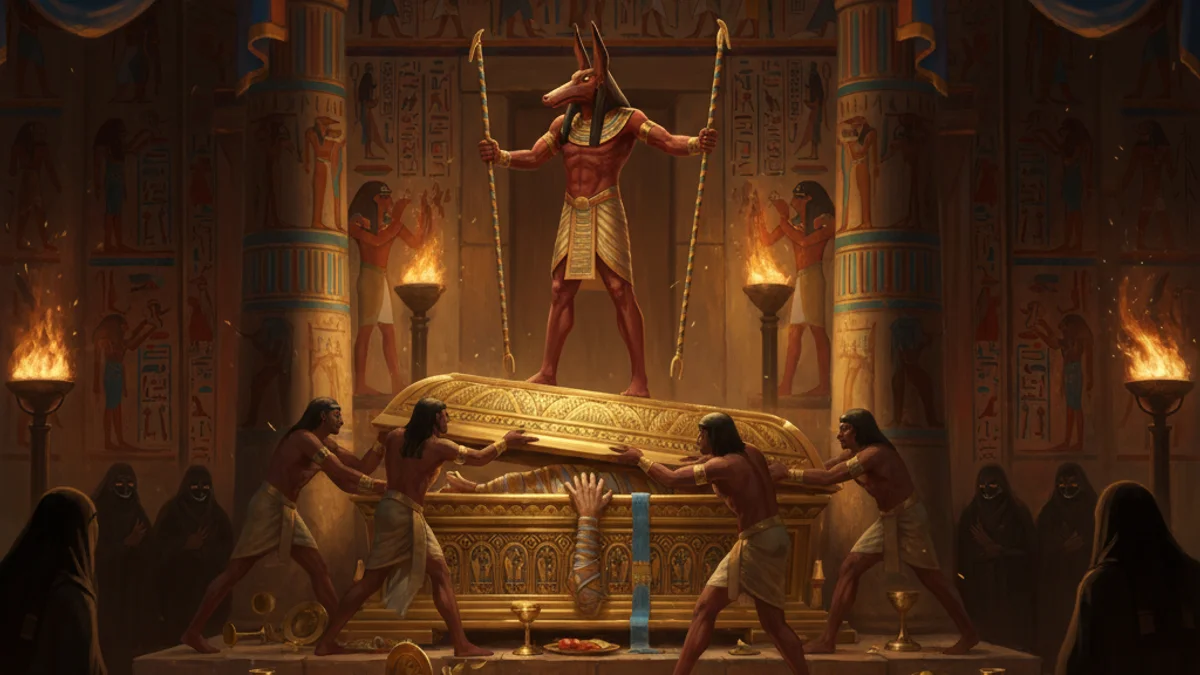
Osiris was the beloved first king of Egypt, a wise ruler who brought agriculture and laws to his people. His brother, Set, grew consumed by envy and plotted to steal the throne. Set secretly obtained Osiris’s measurements and crafted a magnificent chest made of rare woods and gold. At a grand banquet, Set declared he would gift the chest to whoever fit inside perfectly. One by one, the guests tried, but none fit. When Osiris stepped into the chest and lay down, Set and seventy-two conspirators slammed the lid shut, sealed it with molten lead, and cast it into the Nile. Osiris drowned, and the chest drifted to the shores of Byblos. His grieving wife, Isis, eventually found the body, but Set stole it back and tore it into fourteen pieces, scattering them across the land. Undeterred, Isis and her sister Nephthys gathered the fragments. With the help of Anubis, they performed the first mummification. Though he could no longer rule the living, Osiris was resurrected to become the eternal King of the Underworld and the judge of souls.
Jealousy and betrayal may cause temporary destruction, but truth and divine order will eventually transform suffering into an eternal legacy.
Questions about this story
What is the moral of Set Murders Osiris?
The story teaches that while evil and chaos may disrupt the world, love and ritual can restore order. It highlights the transition from physical life to a spiritual, eternal existence.
Why did Set want to kill Osiris?
Set was driven by intense jealousy of Osiris’s popularity and his position as the supreme ruler of Egypt. He desired the throne for himself to spread his own influence of chaos.
What happened to Osiris after he died?
After his body was recovered and mummified by Isis and Anubis, Osiris was resurrected. He became the god of the afterlife and the judge of the dead in the Hall of Truth.
How did Isis find the pieces of Osiris?
Isis traveled across Egypt in the form of a bird, searching for the fourteen scattered parts. She built a shrine at every location where she found a piece of her husband.
Advertisement
Good night.
