
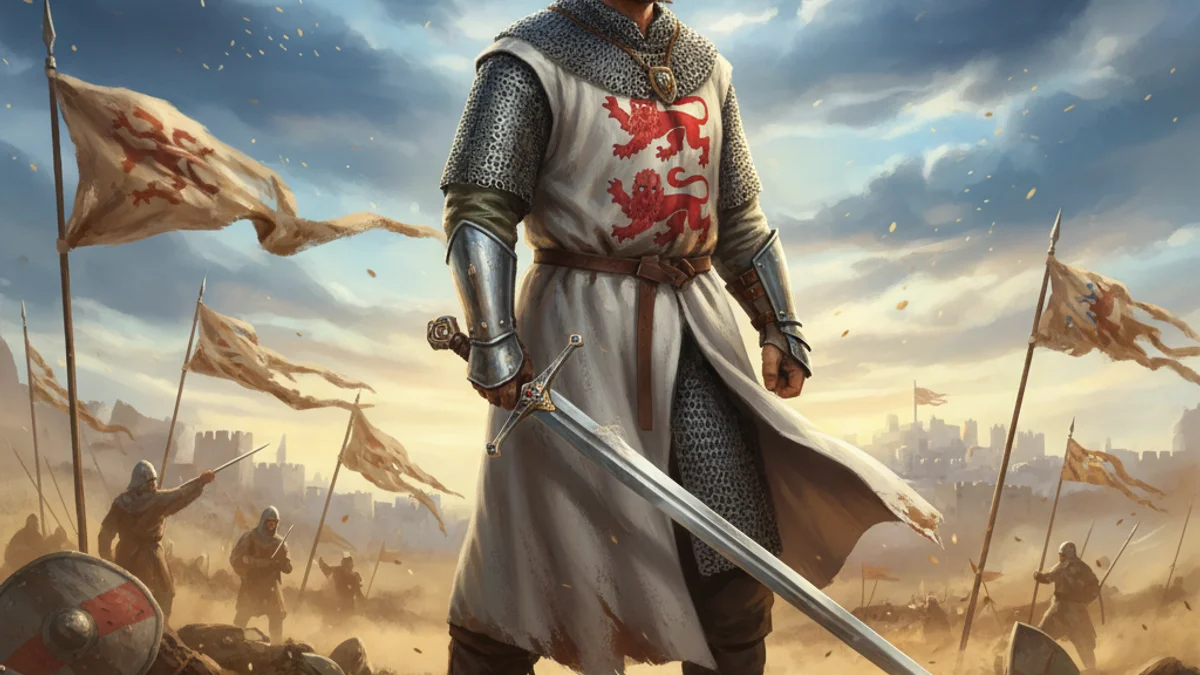
King Richard I of England, better known as Richard the Lionheart, was a monarch defined more by the sword than the scepter. Ascending to the throne in 1189, he immediately turned his gaze toward the Holy Land, joining the Third Crusade. His military genius was unmatched, earning him the respect of his greatest rival, Saladin. Throughout the siege of Acre and the Battle of Arsuf, Richard’s personal bravery became the stuff of legend; he was often seen in the thickest of the fray, wielding his axe with a ferocity that inspired his knights and terrified his foes. However, his return journey was fraught with peril. Captured by Duke Leopold of Austria and handed to the Holy Roman Emperor, Richard became the world's most famous prisoner. Legend tells of his faithful minstrel, Blondel, who traveled from castle to castle singing a secret song until Richard’s voice joined him from a high tower. Though ransomed for a king's ransom, Richard’s life ended not in a grand crusade, but at the siege of a minor castle in Limousin. Struck by a crossbow bolt fired by a boy, the Lionheart died with the same defiance he lived by, forgiving his killer before succumbing to infection.
True greatness is measured not just by victory in battle, but by the legacy of one's character and the ability to inspire others through personal courage.
Questions about this story
What is the moral of Richard the Lionheart?
The story emphasizes that while martial prowess brings fame, true leadership is a balance of bravery and consequence. It teaches that even the most powerful figures are subject to fate and the costs of their own ambitions.
Why was he called the Lionheart?
He earned the nickname 'Cœur de Lion' due to his exceptional courage and ferocity on the battlefield. His reputation as a great military leader and warrior was recognized by both his allies and his enemies.
What was Richard's relationship with Saladin?
Though they were bitter rivals during the Third Crusade, Richard and Saladin maintained a relationship of deep mutual respect. They famously exchanged gifts and compliments, embodying the medieval ideal of chivalry even during war.
How did Richard the Lionheart die?
Richard died in 1199 from an infected wound caused by a crossbow bolt. He was hit while besieging the castle of Châlus-Chabrol in France, reportedly by a young boy seeking revenge for his family.
Advertisement

Good night.
