
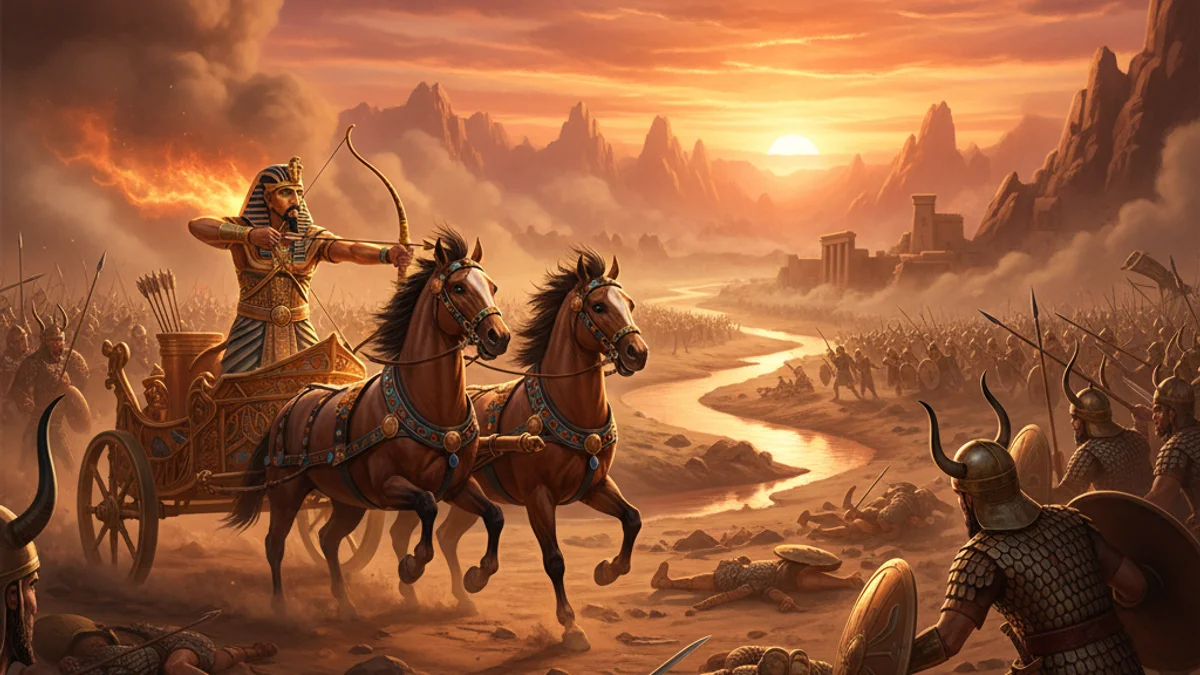
Pharaoh Ramesses II marched his 'Amun' division toward the city of Kadesh, confident of a swift victory. However, Hittite spies deceived him, leading his vanguard into a deadly trap. As the Hittite chariots surged from the shadows, the Egyptian ranks broke in terror, leaving Ramesses isolated and surrounded by thousands of enemies. Standing alone in his golden chariot, the Pharaoh called out to his father, the god Amun, pleading for strength. Legend says Amun gripped his hand, and a divine fire consumed the Pharaoh's spirit. With superhuman fury, Ramesses charged into the Hittite masses, his arrows never missing and his presence terrifying the foe. He held the line single-handedly until his reinforcements arrived, turning a certain massacre into a legendary stalemate that solidified his status as a living god in the eyes of his people.
True strength is found in unwavering faith and the courage to stand alone when others flee.
Questions about this story
What is the moral of Ramesses at Kadesh?
The story teaches that leadership requires immense personal courage and that faith can provide strength in desperate moments. It highlights the importance of resilience when facing overwhelming odds.
Who fought in the Battle of Kadesh?
The battle was fought between the Egyptian Empire under Ramesses II and the Hittite Empire led by Muwatalli II. It is famous for being one of the largest chariot battles in human history.
Did Ramesses II actually win at Kadesh?
While Ramesses claimed a total victory in temple inscriptions, historical evidence suggests the battle was a tactical draw. However, his personal survival and rallying of troops became a legendary feat of royal propaganda.
Which god did Ramesses II call upon?
Ramesses called upon the god Amun, the King of the Gods, when he found himself surrounded. He claimed Amun answered his prayer by giving his arm the strength of hundreds of thousands of men.
Advertisement
Good night.
