
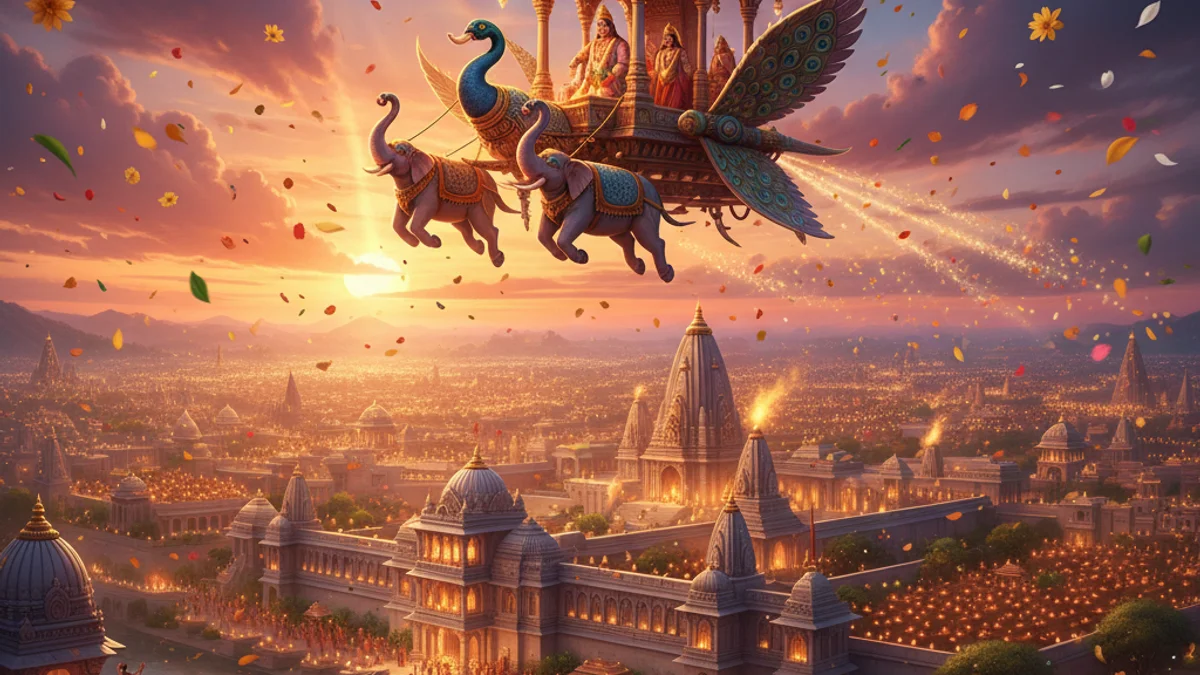
After fourteen years of exile and the climactic defeat of the demon-king Ravana, Lord Rama prepared for his journey home. Alongside his wife Sita, his brother Lakshmana, and his devoted ally Hanuman, he boarded the celestial Pushpaka Vimana. As they soared over the landscape, Rama pointed out the landmarks of their struggle and eventual victory to Sita. In Ayodhya, Prince Bharata anxiously awaited his brother's arrival, having ruled as a regent by placing Rama's sandals on the throne. To guide their king through the moonless night, the citizens of Ayodhya lined the streets with millions of clay lamps, turning the city into a sea of golden light. The air filled with the scent of flowers and the sound of joyous chants. Upon landing, Rama embraced Bharata, reuniting the family and restoring order to the kingdom. His coronation marked the beginning of Ram Rajya, an era of peace, prosperity, and justice.
The ultimate victory belongs to those who follow the path of righteousness and fulfill their duty with patience.
Questions about this story
What is the moral of Rama's Return to Ayodhya?
The story teaches that righteousness (Dharma) always triumphs over evil. It also highlights the importance of keeping one's word and the joy that comes from fulfilling one's duty to family and society.
Which festival celebrates Rama's return to Ayodhya?
Diwali, the Festival of Lights, is celebrated to commemorate the return of Lord Rama. People light lamps to symbolize the victory of light over darkness and knowledge over ignorance.
How long was Rama in exile before returning?
Lord Rama spent fourteen years in exile in the forest. He stayed away to honor the promise his father, King Dasharatha, made to Queen Kaikeyi.
Who ruled Ayodhya while Rama was away?
His younger brother Bharata ruled Ayodhya as a regent. Out of respect, he refused to sit on the throne and instead placed Rama's wooden sandals upon it to signify Rama's true sovereignty.
Advertisement
Teach next
Good night.
