
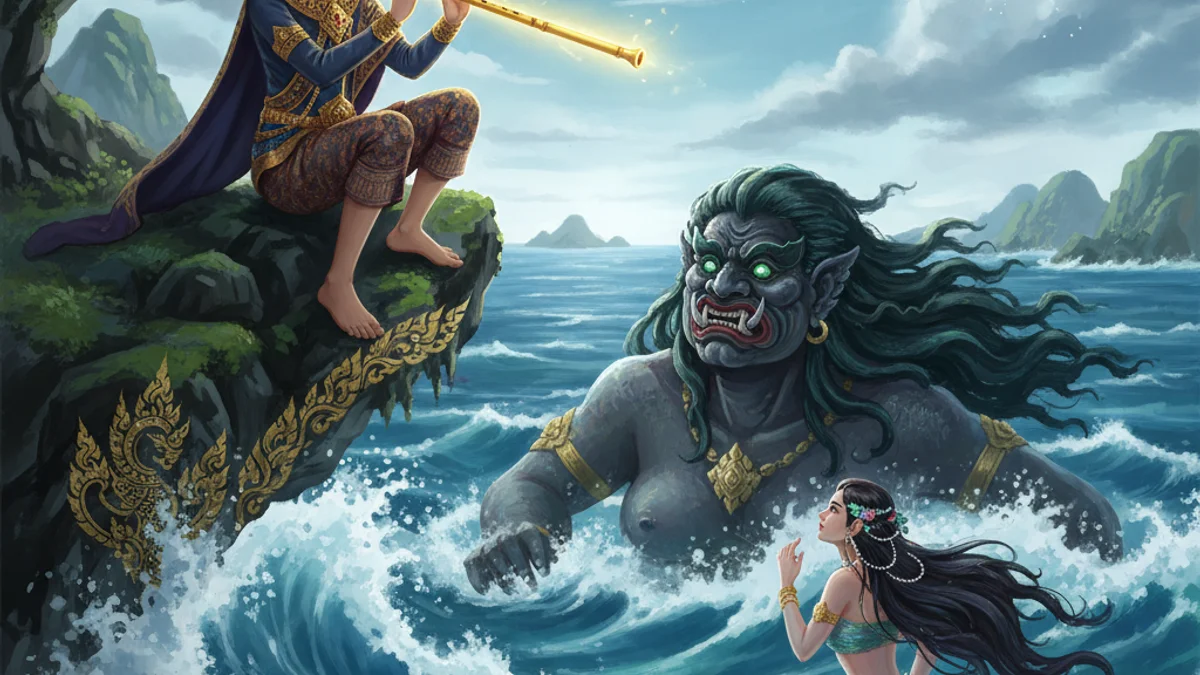
Prince Phra Aphai Mani and his brother Sisuwan were sent by their father to master the arts of kingship. However, Aphai Mani chose to learn the magic flute, while Sisuwan studied sword fighting. Angered by what he deemed useless skills, their father exiled them. During their travels, Aphai Mani was kidnapped by the Ogress Pisua Samut, who disguised herself as a beautiful woman. They lived together for years and had a son, Sin Samut, but Aphai eventually discovered her true form. With the help of a family of mermaids and a powerful hermit on the magical island of Ko Kaeo Phitsadan, Aphai Mani escaped. The Ogress pursued them in a jealous rage, but Phra Aphai Mani played his enchanted flute, producing a melody so mournful and powerful that it caused the Ogress’s heart to burst. Throughout his long journey, the prince encountered mythical creatures, foreign lands, and complex romances, eventually proving that the power of art and wisdom could overcome even the most terrifying brute force.
True strength lies not in physical violence or deception, but in the mastery of one's talents and the wisdom to see beyond appearances.
Questions about this story
What is the moral of Phra Aphai Mani?
The story teaches that intellectual and artistic pursuits, like music, can be more powerful than physical weapons. it also warns that love built on deception, like the Ogress's disguise, is destined to fail.
Who wrote the epic of Phra Aphai Mani?
The story was written by Sunthorn Phu, Thailand's most renowned poet, during the early 19th century. It is considered one of the greatest works of Thai literature due to its imaginative scope and poetic beauty.
What are the powers of the magic flute?
The flute has the power to charm listeners, put entire armies to sleep, or even kill enemies depending on the melody played. Phra Aphai Mani uses it as his primary defense instead of traditional weapons.
Who is Sud Sakorn in the story?
Sud Sakorn is the son of Phra Aphai Mani and the Mermaid. He becomes a hero in his own right, riding a mythical dragon-horse and embarking on a quest to find his father.
Advertisement

Good night.
