
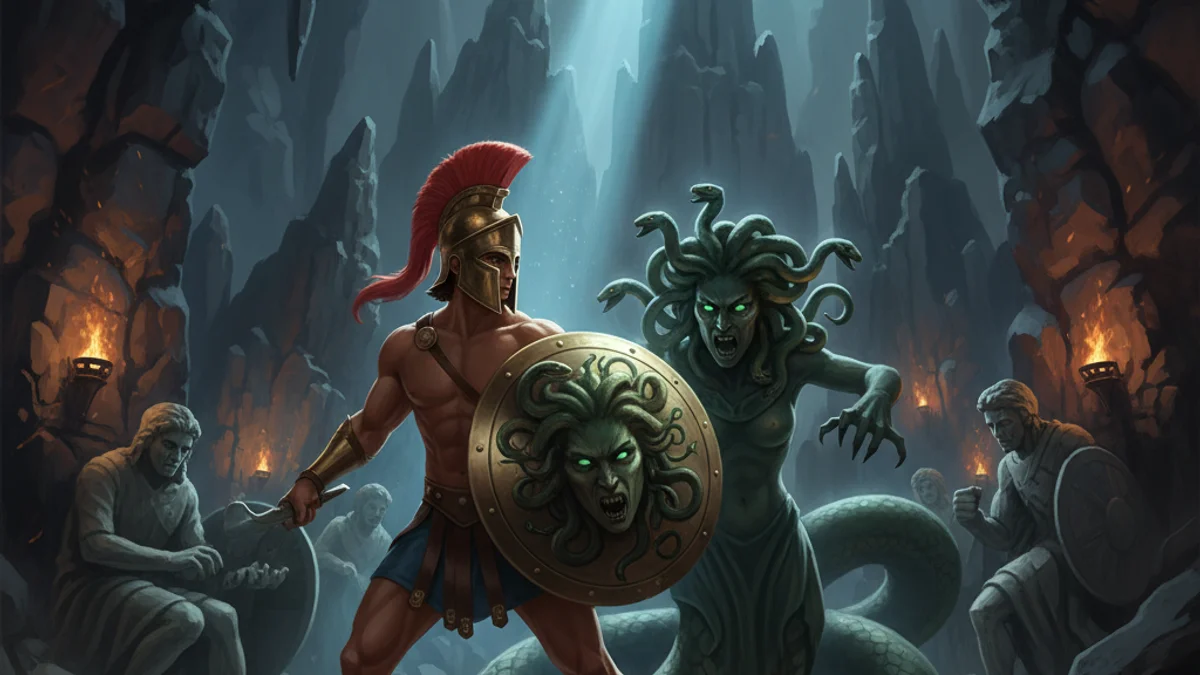
To protect his mother from the unwanted advances of King Polydectes, the young hero Perseus was sent on a seemingly impossible quest: to bring back the head of the Gorgon Medusa, a monster whose gaze turned any living thing into stone. Recognizing the boy's bravery, the gods Athena and Hermes provided him with divine tools—winged sandals for flight, a cap of invisibility, a curved sickle, and a highly polished bronze shield. Guided by the gods, Perseus first sought the Graeae to learn the Gorgons' location. Upon arriving at the monsters' lair, he found the sisters asleep amidst a garden of frozen stone victims. Using the reflection in his shield to avoid looking directly at her, Perseus descended. With one swift stroke of his sickle, he decapitated Medusa. From her neck sprang the winged horse Pegasus. Stowing the head in a magic bag, Perseus used his invisibility to escape her vengeful sisters, eventually using the head's power to defeat his enemies and fulfill his destiny.
With the right tools, divine guidance, and the courage to act indirectly when faced with overwhelming power, one can overcome even the most terrifying obstacles.
Questions about this story
What is the moral of Perseus and Medusa?
The story teaches that courage combined with wisdom and the right preparation can defeat even 'unbeatable' foes. It also emphasizes that some problems must be faced indirectly rather than through a head-on confrontation.
How did Perseus kill Medusa without turning to stone?
Perseus used a polished bronze shield given to him by Athena to view Medusa’s reflection. This allowed him to track her movements and strike her without looking directly into her petrifying eyes.
What divine gifts did Perseus receive for his quest?
He received winged sandals for flight from Hermes, a helm of invisibility from Hades, a curved sword or sickle, and a mirrored shield from Athena to safely navigate the Gorgon's lair.
Why did Medusa have snakes for hair?
In later mythological traditions, Medusa was originally a beautiful woman who was cursed by the goddess Athena. As a punishment for an encounter in Athena's temple, her hair was transformed into venomous snakes.
Advertisement

Good night.
