
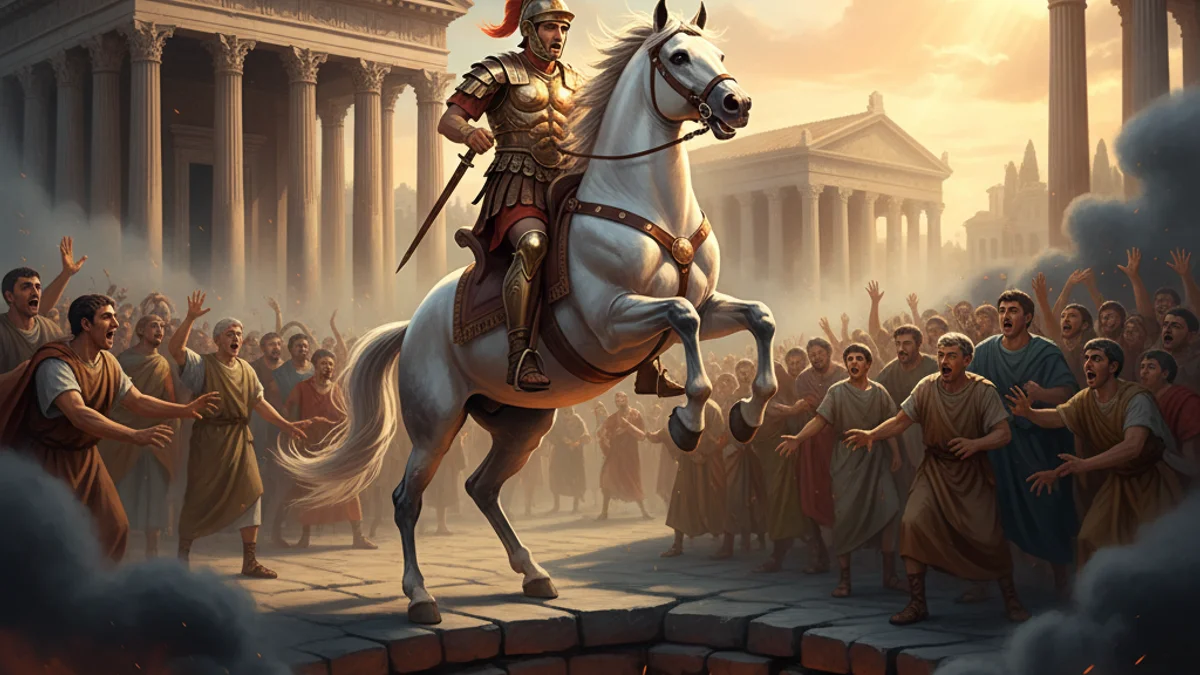
In the year 362 BCE, a massive chasm suddenly split the earth in the middle of the Roman Forum. No matter how much debris the citizens threw into the abyss, it remained bottomless and threatening. Desperate, the Romans consulted an oracle, who proclaimed that the chasm would only close when Rome sacrificed its most precious possession. While others debated whether the gods demanded gold or grain, a young soldier named Marcus Curtius stepped forward. He declared that Rome's greatest strength lay in the courage and arms of its citizens. Donning his finest armor and mounting his warhorse, Curtius invoked the gods and plunged headlong into the darkness. The earth immediately sealed shut over him, preserving the city and immortalizing his name as the ultimate symbol of Roman devotion to the state.
The greatest treasure of a nation is the courage of its people, and self-sacrifice for the common good is the highest virtue.
Questions about this story
What is the moral of Marcus Curtius Leaps into the Chasm?
The story teaches that civic virtue and the willingness to sacrifice oneself for the greater good are a nation's most valuable assets. It emphasizes that a society is preserved through the courage of its individuals.
Where did the chasm in the story appear?
The chasm appeared in the Roman Forum, the heart of ancient Rome's political and social life. The specific spot became known as the Lacus Curtius and remained a landmark for centuries.
Who was Marcus Curtius in Roman mythology?
Marcus Curtius was a legendary Roman youth and soldier. He is celebrated as a hero who recognized that 'arms and valor' were the true foundations of the Roman Republic's power.
Was Marcus Curtius a real historical figure?
While the story is treated as a legend, Marcus Curtius is a staple of Roman pseudohistory recorded by historians like Livy. The tale served to explain the naming of the Lacus Curtius site in the Forum.
Advertisement

Good night.
