
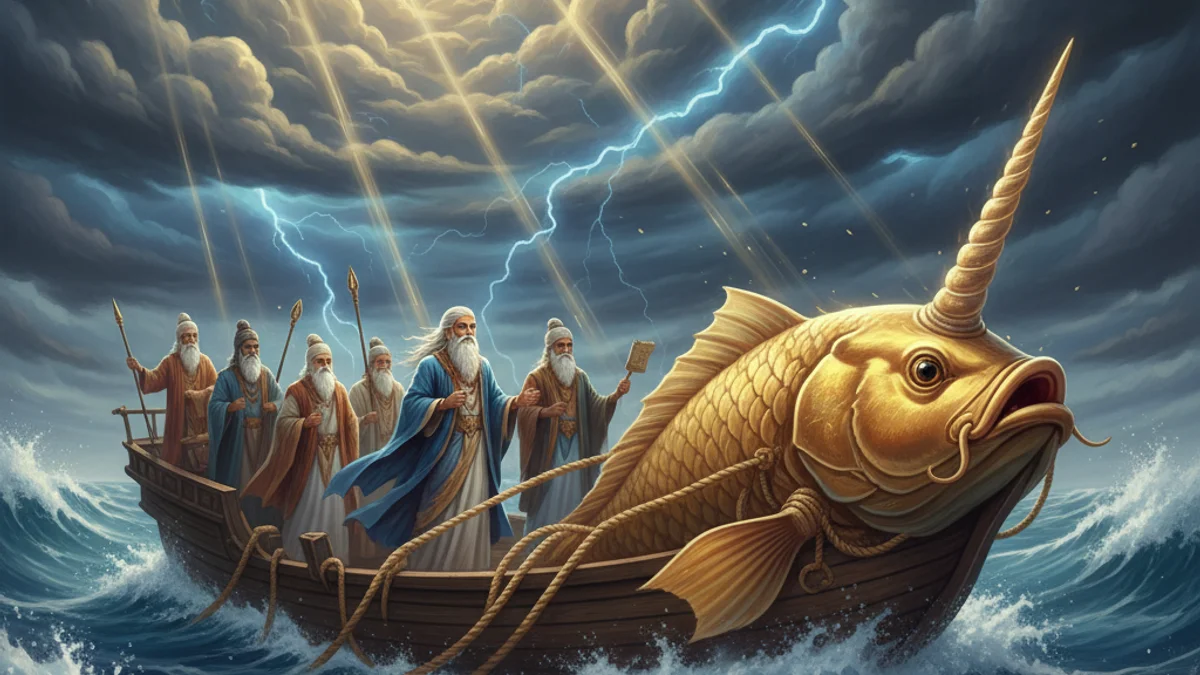
One morning, while the sage-king Manu was washing his hands in a river, a tiny fish swam into his palms. The fish pleaded for protection, fearing the larger creatures in the water. Moved by compassion, Manu placed the fish in a small jar. By the next morning, the fish had grown too large for the jar, so Manu moved it to a pond. Soon, the pond was too small, and the fish was transferred to the Ganges, and finally to the vast ocean. Realizing the fish was divine, Manu listened as the creature, now an enormous golden avatar named Matsya, warned of a catastrophic flood that would soon cleanse the world. Matsya instructed Manu to build a massive ship and gather the seeds of all plants and the seven great sages. When the deluge arrived, Matsya returned with a great horn on its head. Manu tied his ship to the horn using the giant serpent Vasuki as a rope. The fish guided the boat through the stormy waters until they reached the peaks of the Himalayas, where Manu waited for the waters to recede to begin the world anew.
Compassion toward the smallest of beings can lead to divine salvation, and those who live righteously are protected during times of chaos.
Questions about this story
What is the moral of Manu and the Fish?
The story teaches that kindness toward all living things, no matter how small, brings great rewards. It also emphasizes the importance of foresight and living a life of dharma to survive life's storms.
Who is the fish in the story of Manu?
The fish is Matsya, the first avatar of the god Vishnu. He took this form specifically to guide Manu and preserve life on Earth during the great flood.
How does this story compare to Noah's Ark?
Both stories feature a righteous man warned by a divine power of a coming flood, the building of a vessel, and the preservation of life. However, Manu is guided by a giant fish rather than building the ark alone.
What did Manu carry on his boat?
Unlike Noah, who saved pairs of animals, Manu was instructed to save the seeds of all plants and the Saptarishi, or the seven great sages, to ensure knowledge and nature could be reborn.
Advertisement

Good night.
