Story Summary
Discover the classic tale of Lincoln and the Pig, where Honest Abe ruins his suit to rescue a trapped animal, proving that even small acts of mercy matter.
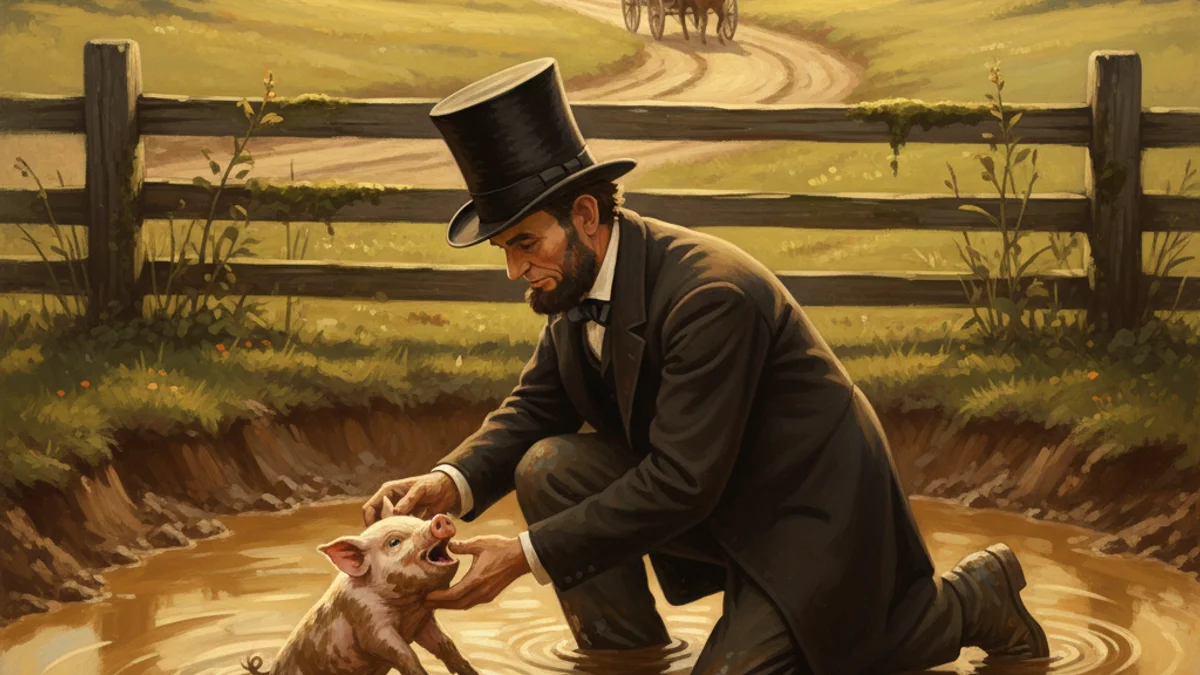
One afternoon, Abraham Lincoln was riding in a carriage with a group of friends through the muddy Illinois countryside. As they traveled, Lincoln was engaged in a deep philosophical debate, arguing that all good deeds are fundamentally selfish because they are done to make the doer feel better. Suddenly, they passed a thicket where a mother pig was squealing piteously because her piglets were stuck in a deep slough of mud. Lincoln glanced at the scene but continued the conversation. However, after a mile, he abruptly asked the driver to stop. He hopped out, ran back to the mud hole, and ruined his fine clothes while lifting the piglets to safety. When he returned to the carriage, his friends teased him, claiming he had just proven himself wrong by performing a selfless act. Lincoln shook his head and replied, 'I did it to get peace of mind, don't you see? I would have had no peace all day if I had left that suffering creature.'
The Moral
True compassion often stems from an internal need to do what is right, proving that our own peace of mind is tied to the well-being of others.
“I did it to get peace of mind, don't you see?”
Fun Fact
This anecdote is so famous in philosophical circles that it is often used by ethics professors to debate whether 'pure' altruism actually exists.
Frequently Asked Questions
What is the moral of Lincoln and the Pig?
The moral is that true kindness is an internal necessity. Lincoln argued that helping others provides the 'peace of mind' required to live with oneself, suggesting that empathy is a vital human instinct.
Is the story of Lincoln and the pig true?
While it is widely cited as a historical anecdote, many historians consider it apocryphal or a legendary embellishment. Regardless of its literal accuracy, it perfectly captures the empathetic character for which Lincoln was known.
Who was Lincoln with when he saved the pig?
The story often places Lincoln in a carriage with his law partner, William Herndon, or other associates during his time as a circuit-riding lawyer in Illinois.
Why did Lincoln save the pig according to the story?
Lincoln claimed he saved the pig for a selfish reason: to relieve his own conscience. He explained that if he hadn't helped, the memory of the suffering animal would have haunted him all day.
What philosophy does this story illustrate?
This story is frequently used to illustrate the concept of psychological egoism. It explores the idea that even our most altruistic actions are motivated by a desire for personal satisfaction or the avoidance of guilt.
What happened to Lincoln's clothes in the story?
In most versions of the tale, Lincoln completely ruins his clean suit and boots in the thick Illinois mud. This detail emphasizes that he valued the animal's life over his own appearance and property.
Discussion (0)
Share your thoughts on this story
No comments yet. Be the first to share your thoughts!