
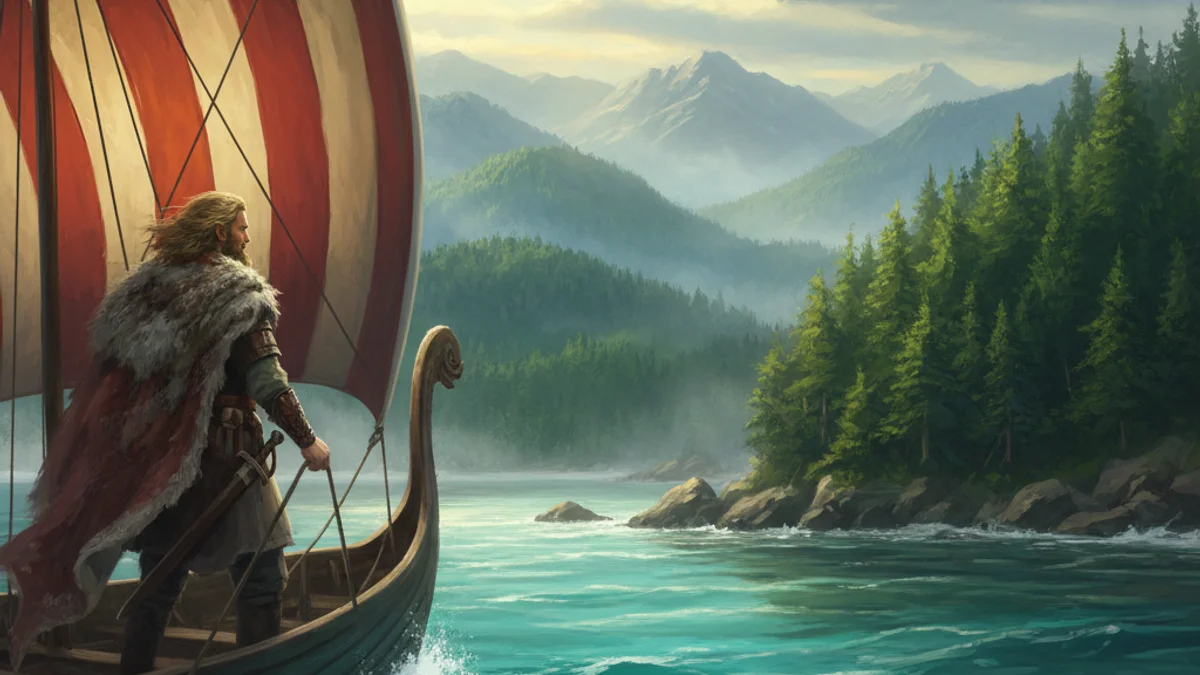
Leif Erikson, son of Erik the Red, was a man of restless spirit and keen intellect. Hearing tales from the merchant Bjarni of land sighted far to the west, Leif bought Bjarni's ship and gathered a crew of thirty-five brave souls. Setting sail from Greenland, he first encountered a land of flat stones and ice, which he named Helluland. Further south, they found a forested coast of white sand, naming it Markland. Finally, the winds carried them to a lush, fertile territory where the rivers teemed with salmon and the grass stayed green through the winter. It was here that Leif’s foster-father, Tyrker, discovered wild grapes, leading Leif to name the country Vinland. They built large houses and wintered there, marveling at the abundance of the land before returning to Greenland laden with timber and vines. Leif’s voyage proved that the world was far larger than the Vikings had ever imagined, marking the first European footprint on North American soil.
True discovery requires the courage to follow the horizon and the wisdom to prepare for the journey.
Questions about this story
What is the moral of Leif Erikson Discovers Vinland?
The story emphasizes that greatness is achieved through curiosity and the bravery to explore beyond the known world. It teaches us that preparation and leadership are essential when facing the unknown.
Where was the legendary Vinland located?
Historical and archaeological evidence, such as the site at L'Anse aux Meadows, suggests Vinland was located in modern-day Newfoundland, Canada. It was praised by the Vikings for its mild climate and abundant resources.
Who was Leif Erikson?
Leif Erikson was a Norse explorer and the son of Erik the Red, the founder of the first Norse settlement in Greenland. He is widely believed to be the first European to set foot on continental North America.
How did Vinland get its name?
The land was named Vinland, or 'Wineland,' because Leif's foster-father, Tyrker, found wild grapes growing there. These grapes were a valuable resource for making wine, which was highly prized by the Vikings.
Advertisement

Good night.
