
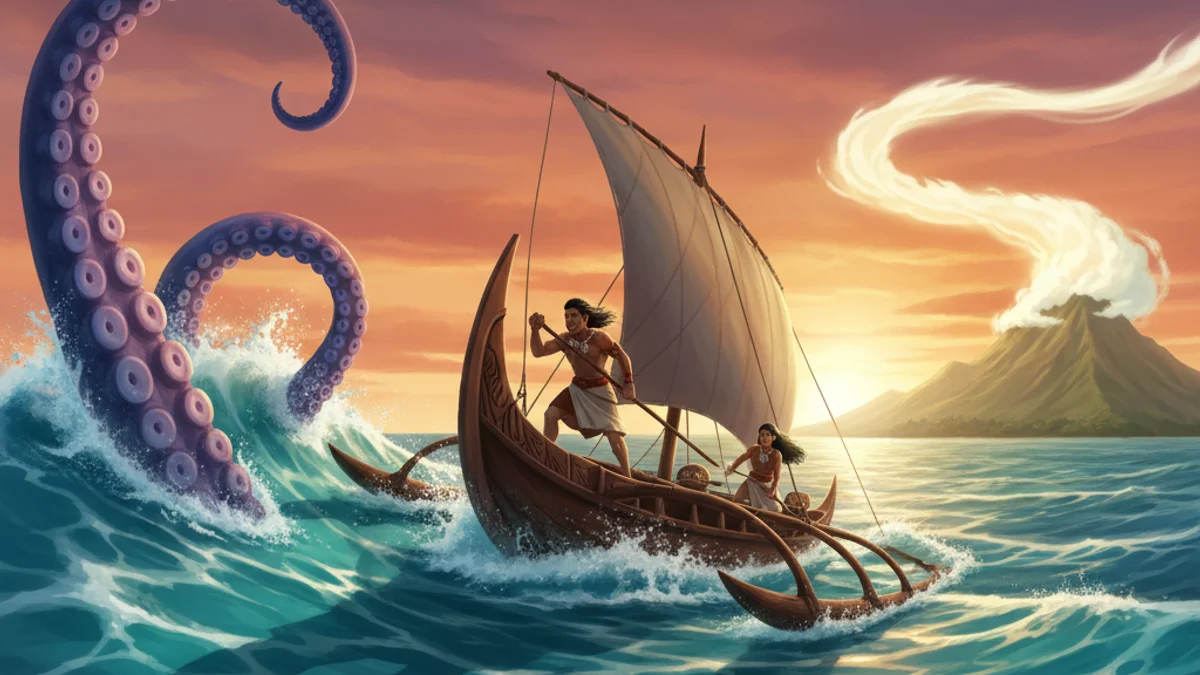
In the ancient homeland of Hawaiki, the great navigator Kupe found his people’s fishing lines empty. A giant octopus, Te Wheke-a-Muturangi, was stealing their catch and retreating into the deep. Determined to protect his people’s livelihood, Kupe vowed to slay the beast and set out in his great waka, Matahorua. The chase was relentless, spanning the vast, uncharted Pacific for many weeks. As the sun beat down and the stars guided them south, Kupe’s wife, Hine-te-aparangi, eventually sighted a long, white cloud on the horizon—a sure sign of land. They had reached a lush, green wilderness unlike any they had seen. In the turbulent waters of what is now the Cook Strait, Kupe finally cornered and defeated the great octopus in a fierce battle. Having explored the rugged coastlines of this new world, which they named Aotearoa, the Land of the Long White Cloud, Kupe returned to Hawaiki to share the navigation stars and stories of the magnificent discovery that would eventually become the home of the Māori people.
Persistence in the face of adversity and a spirit of exploration can lead to life-changing discoveries.
Questions about this story
What is the moral of Kupe Discovers Aotearoa?
The moral is that persistence and a spirit of adventure can lead to transformative discoveries. By following his challenge to the end, Kupe found a new home for his people.
Who was Kupe in Polynesian mythology?
Kupe was a legendary Polynesian explorer and master navigator from the ancestral homeland of Hawaiki. He is credited in Māori oral tradition with being the first person to discover New Zealand.
What does the name Aotearoa mean?
Aotearoa is the Māori name for New Zealand, most commonly translated as 'Land of the Long White Cloud.' It refers to the mist and clouds that signaled land to Kupe's crew.
Why was Kupe chasing a giant octopus?
Kupe chased the octopus, Te Wheke-a-Muturangi, because it was stealing the fish and bait from his tribe's fishing lines. The pursuit led him across the Pacific Ocean to the shores of New Zealand.
Advertisement
Good night.
