
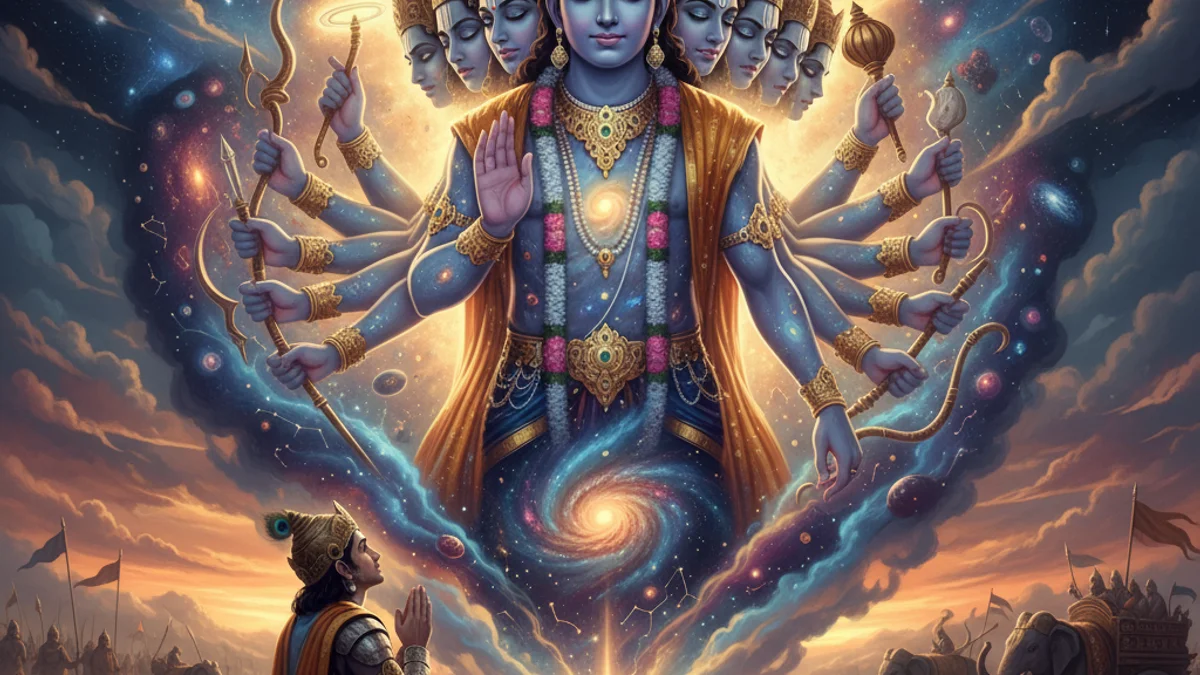
On the battlefield of Kurukshetra, Prince Arjuna stood paralyzed by grief and moral dilemma, refusing to fight against his own kin. To guide him, his charioteer, Lord Krishna, imparted the profound wisdom of the Bhagavad Gita. When Arjuna requested to see Krishna’s divine sovereignty, the Lord granted him celestial vision. Instantly, Krishna transformed into the Vishwarupa—the Universal Form. He appeared with infinite faces, countless eyes, and bodies stretching across the cosmos, containing all gods, stars, and time itself. Arjuna witnessed the beginning and the end of all existence within Krishna’s radiant being. Trembling with awe and fear, Arjuna realized that Krishna was the supreme reality behind all creation, leading him to shed his ego and embrace his duty with newfound clarity and devotion.
The divine encompasses all of existence, and one must perform their righteous duty with faith in the supreme cosmic order.
Questions about this story
What is the moral of Krishna Reveals His Universal Form?
The story teaches that the divine is omnipresent and that human life is part of a much larger cosmic plan. It encourages individuals to fulfill their dharma, or duty, without being attached to the results.
Why did Krishna show his universal form to Arjuna?
Krishna revealed the Vishwarupa to remove Arjuna's doubts and demonstrate that he is the ultimate source of all creation, destruction, and moral order.
What does 'Vishwarupa' mean?
Vishwarupa translates to 'Universal Form' or 'Omni-form,' representing the totality of the universe manifested as a single divine being.
Which Hindu scripture contains this story?
This iconic revelation occurs in the 11th chapter of the Bhagavad Gita, which is a part of the great Indian epic, the Mahabharata.
Advertisement
Good night.
