
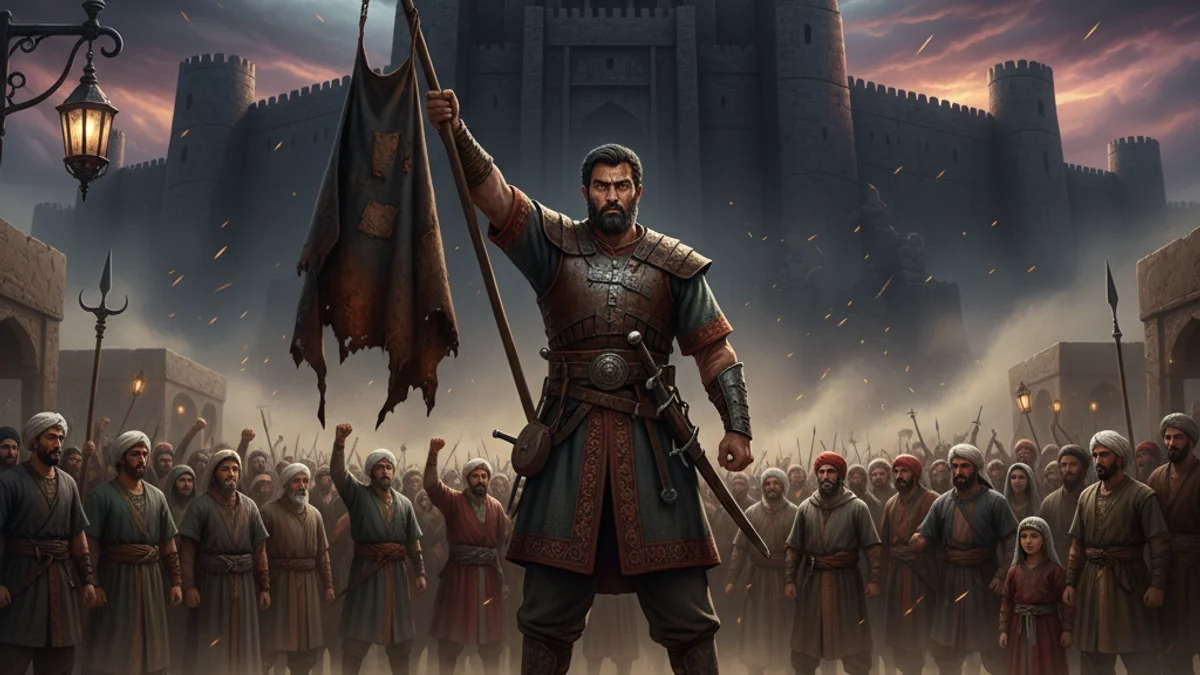
The land of Persia groaned under the rule of King Zahhak, a tyrant cursed with two serpents growing from his shoulders. To appease the hunger of these snakes, Zahhak demanded the brains of two young men every day. When Kaveh, a humble blacksmith, lost seventeen of his eighteen sons to this cruelty, his grief turned to iron-willed defiance. Summoned to the palace to sign a document testifying to Zahhak's 'justice,' Kaveh instead tore the paper apart in fury. He marched out, fixed his heavy leather blacksmith’s apron to a spear, and raised it as a banner—the Derafsh Kaviani. This simple tool became a symbol of resistance, rallying the oppressed masses. Kaveh led the people to find Fereydun, the rightful heir to the throne. Together, the blacksmith and the prince led a revolution that overthrew the tyrant, binding Zahhak in chains within Mount Damavand and restoring light to the realm.
Tyranny is not invincible; the courage of a single person, supported by the unity of the people, can topple even the most powerful oppressor.
Questions about this story
What is the moral of Kaveh the Blacksmith?
The story teaches that justice and freedom are worth fighting for, even against overwhelming odds. It highlights that true power resides in the unity of the common people against tyranny.
Who was King Zahhak in Persian mythology?
Zahhak was an evil king who was manipulated by Ahriman and had two snakes growing from his shoulders. He represented the personification of cruelty and the ultimate test for the Persian people.
What is the Derafsh Kaviani?
The Derafsh Kaviani, or the 'Banner of Kaveh,' was the legendary flag of ancient Persia made from Kaveh's leather apron. It became a sacred symbol of national independence and royal power.
Why did Kaveh lead a rebellion?
Kaveh rebelled after King Zahhak ordered the sacrifice of his eighteenth and last remaining son. His personal loss drove him to demand justice for all families suffering under the king's rule.
Advertisement


Good night.
