
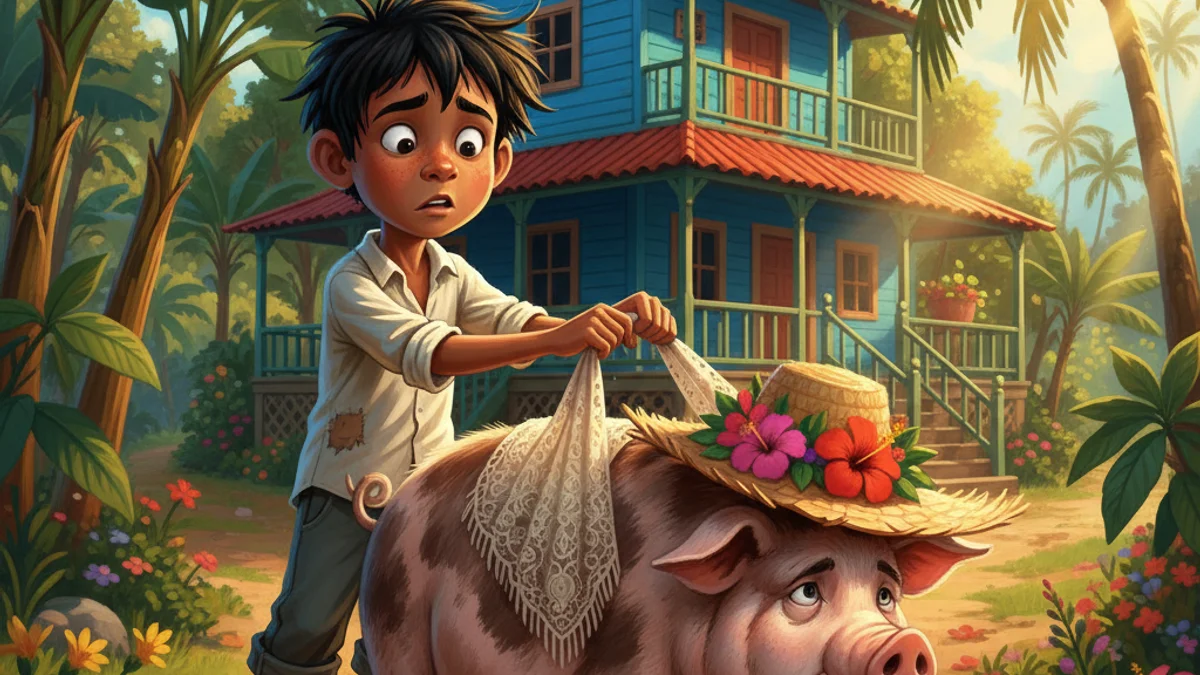
In the lush hills of Puerto Rico lived Juan Bobo, a boy whose name meant 'Simple John.' One Sunday, his mother prepared to head to Mass, leaving Juan in charge of the family pig. 'Don't let the pig feel lonely,' she cautioned. Taking her words literally, Juan noticed the pig's muddy appearance and decided she deserved to look her best for the day. He raided his mother's wardrobe, dressing the pig in a fine lace shawl, a flowered Sunday hat, and even pinning her gold earrings to the pig's ears. When the pig squealed and ran into the muddy forest, Juan chased after her, shouting that she would ruin her fancy clothes. His mother returned to find her finery ruined and the pig stuck in a bog, realizing that while Juan followed her words to the letter, he lacked the common sense to understand their meaning.
Following instructions literally without using common sense or understanding context leads to foolish mistakes.
Questions about this story
What is the moral of Juan Bobo Tales?
The moral is that intelligence requires more than just following directions; it requires common sense and the ability to interpret intentions. Juan's literal-mindedness serves as a humorous warning against lack of practical wisdom.
Who is Juan Bobo in Puerto Rican culture?
Juan Bobo is the most iconic folk hero of Puerto Rico, representing the 'jibaro' or country person. While he is often called 'silly,' he sometimes accidentally triumphs over more sophisticated characters through his innocence.
What does the name 'Juan Bobo' mean?
In Spanish, 'Juan' is a common name and 'Bobo' translates to 'silly,' 'foolish,' or 'simpleton.' The name characterizes his role as a 'numskull' or 'noodlehead' figure in folklore.
What are the most popular Juan Bobo stories?
The most famous stories include Juan Bobo and the Pig, where he dresses a pig in his mother's clothes, and Juan Bobo and the Ducklings, where he tries to sell goods to inanimate objects.
Advertisement

Good night.
