
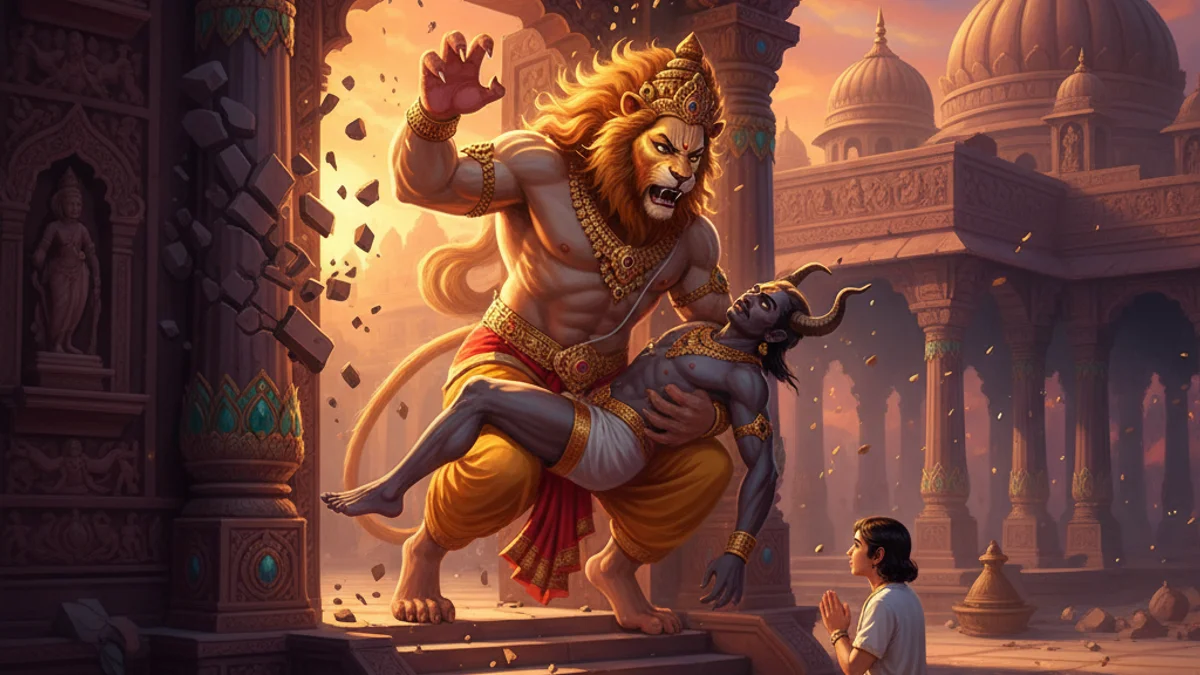
Hiranyakashipu, a powerful demon king, secured a boon from Brahma that made him nearly immortal: he could not be killed by man or beast, indoors or outdoors, during day or night, nor by any weapon. Blinded by arrogance, he demanded the world worship him. However, his young son, Prahlada, remained a steadfast devotee of Lord Vishnu. Enraged by this 'betrayal,' the king attempted to execute his son through various means—poison, trampling by elephants, and fire. In one famous attempt, the king’s sister Holika, who was immune to fire, sat with Prahlada in a bonfire, but she burned to death while Prahlada emerged unscathed. Finally, challenging his son's faith, the king smashed a palace pillar, asking if Vishnu was inside. From the pillar emerged Narasimha, a half-man, half-lion avatar. At twilight (neither day nor night), on the threshold (neither inside nor out), Narasimha placed the king on his lap and killed him with his claws, fulfilling the conditions of the boon while ending his tyranny.
Unwavering faith and righteousness will always triumph over arrogance and evil, no matter how powerful the oppressor seems.
Advertisement
Questions about this story
What is the moral of Hiranyakashipu and Prahlada?
The story teaches that ego and power cannot defeat true devotion. It illustrates that the divine protects those who remain righteous despite facing immense hardship.
What was the boon given to Hiranyakashipu?
He was granted a boon that he could not be killed by any created being, inside or outside a residence, during day or night, on the ground or in the sky, or by any weapon.
Who is Narasimha in Hindu mythology?
Narasimha is the fourth avatar of Lord Vishnu. He is depicted with a lion's head and a human torso, specifically manifested to bypass Hiranyakashipu's complex boon.
How does this story relate to the festival of Holi?
The failure of Holika to burn Prahlada is celebrated as Holika Dahan. This event signifies the victory of good over evil and precedes the colorful celebration of Holi.
Advertisement
