
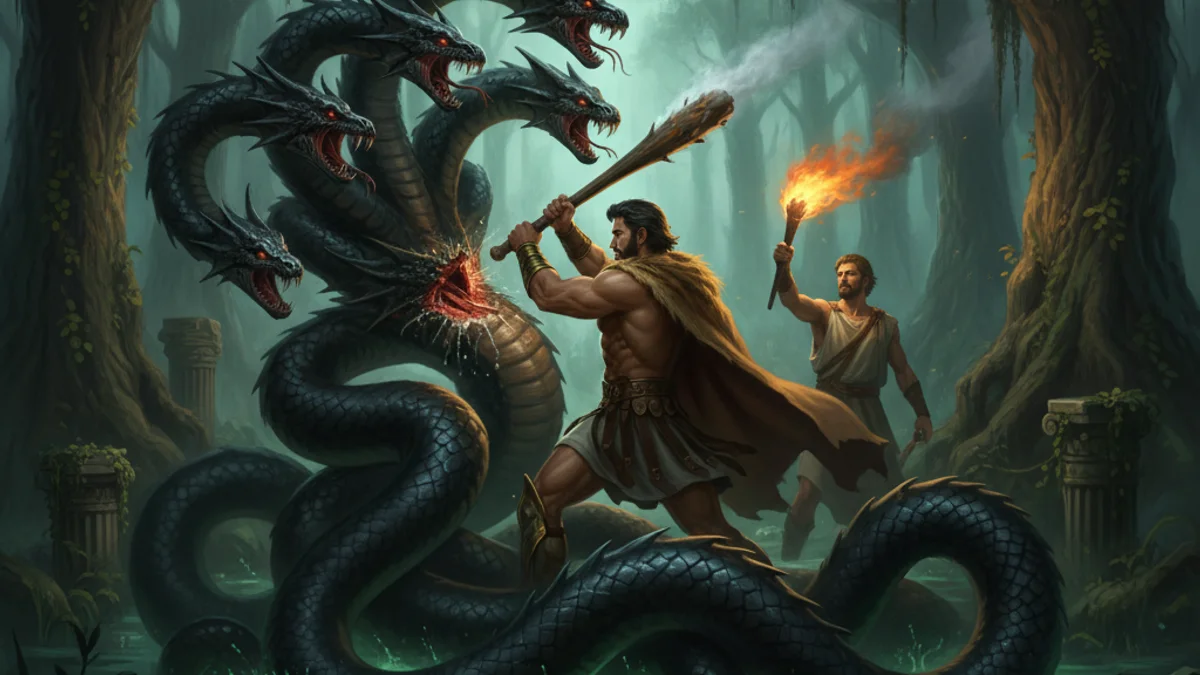
Tasked with his second labor, Hercules traveled to the murky swamps of Lerna to slay the Hydra, a monstrous serpent with nine heads. The beast was a formidable foe; whenever Hercules severed one head with his sword, two more would grow in its place. Realizing that brute force alone would not prevail, Hercules called upon his nephew, Iolaus, for assistance. As Hercules cut off each head, Iolaus used a flaming torch to cauterize the stumps, preventing the heads from regenerating. When only the central, immortal head remained, Hercules crushed it beneath a massive rock and buried it deep in the earth. To ensure his victory had lasting power, he dipped his arrows in the Hydra's poisonous blood. Though King Eurystheus later claimed the labor did not count because Hercules had help, the hero’s victory over the regenerating monster remains one of his most iconic feats.
True strength lies in the ability to adapt your strategy and accept help when facing an overwhelming or recurring problem.
Advertisement
Questions about this story
What is the moral of Hercules and the Lernaean Hydra?
The story teaches that some problems cannot be solved with force alone; success often requires strategic thinking and the humility to accept assistance from others.
How many heads did the Hydra have?
While accounts vary, most myths state the Hydra had nine heads, with the central one being immortal and the others regenerating two-fold when severed.
Who helped Hercules defeat the Hydra?
Hercules was aided by his nephew, Iolaus, who used a torch to sear the Hydra's neck stumps so new heads could not grow back.
Why did the Hydra's heads keep growing back?
The Hydra possessed a supernatural regenerative ability; whenever one head was cut off, two new ones sprouted instantly to replace it.
Advertisement

