
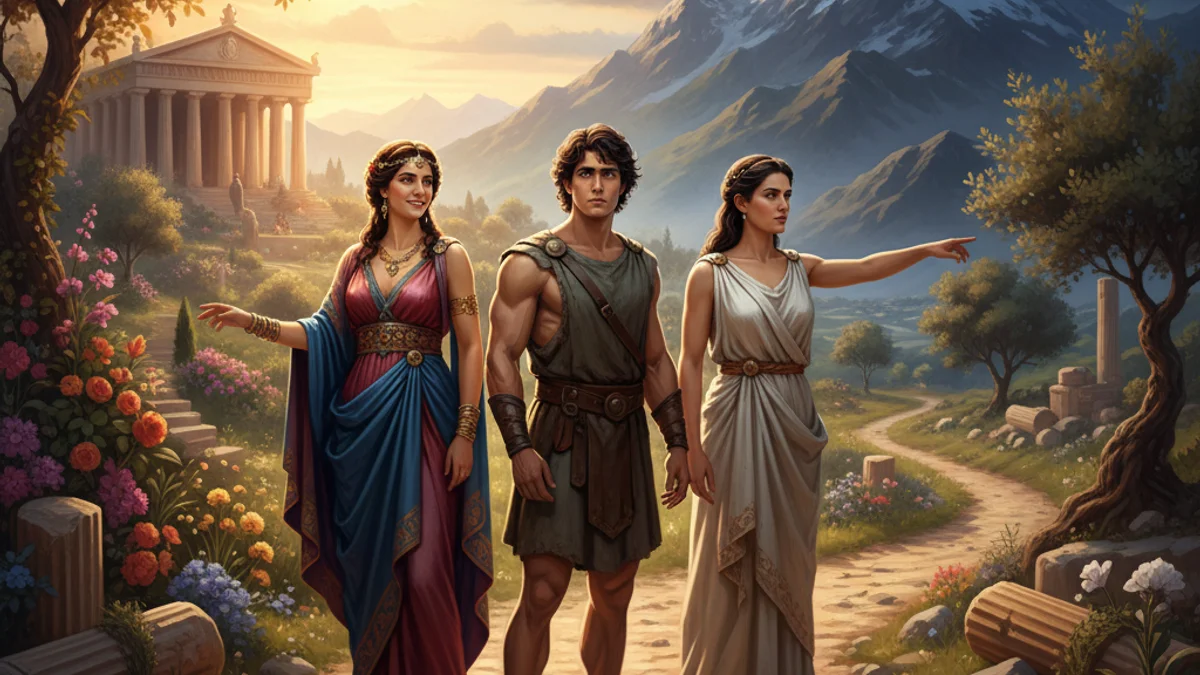
Long ago, before the Labors that would define his legacy, the young hero Heracles sat at a quiet crossroads, contemplating his future. As he pondered, two women of great stature approached him. The first, draped in fine silks and heavy jewels, hurried forward with a seductive smile. She was Kakia, representing Vice and Pleasure. She promised Heracles a life of absolute ease, where every desire would be met without effort and no pain would ever touch his soul. The second woman, Arete, representing Virtue, spoke with a steady, noble voice. She did not hide the truth: her path was one of sweat, hardship, and grueling toil. However, she promised that through such labor, Heracles would earn the love of the gods, the respect of men, and a legacy that would never fade. Looking past the shimmering mirage of instant gratification, Heracles recognized that true greatness required sacrifice. He rose, turned his back on the path of ease, and followed Arete into the rugged mountains, choosing a life of duty over a life of comfort.
True greatness and lasting fulfillment are earned through hard work, integrity, and discipline rather than through a life of easy pleasure.
Questions about this story
What is the moral of Heracles at the Crossroads?
The story teaches that a meaningful life requires choosing discipline and virtue over easy gratification. It emphasizes that lasting rewards and true honor come only through effort and character.
Who are the two women in the story?
The women are Arete, personifying Virtue, and Kakia, personifying Vice or Pleasure. They represent the fundamental internal conflict between short-term desire and long-term purpose.
Why is this story important in Greek mythology?
It serves as a foundational 'choice' myth that explains Heracles' heroic nature. it justifies his many legendary sufferings as a deliberate, noble path toward divinity and honor.
Who wrote the story of Heracles at the Crossroads?
The story was originally composed by the Sophist Prodicus in the 5th century BCE. It was later famously preserved and popularized by the historian Xenophon in his work 'Memorabilia.'
Advertisement

Good night.
