
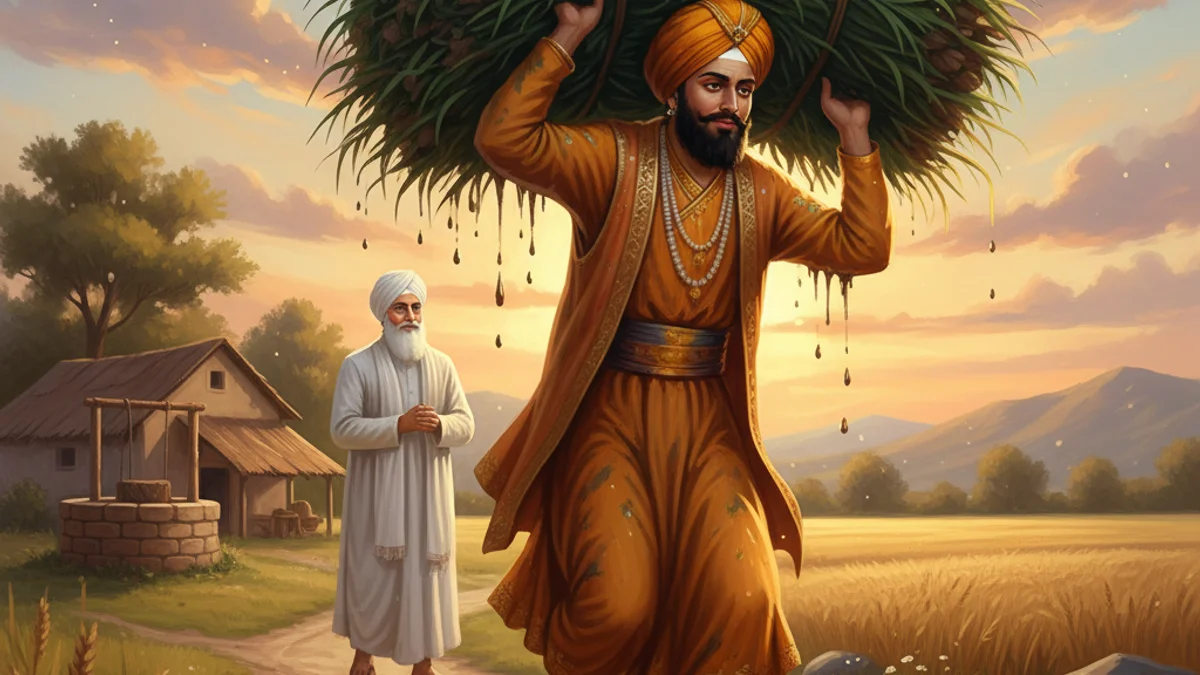
Before he became the second Sikh Guru, he was known as Bhai Lehna. Though he was a man of status, his heart found its home in the selfless service of Guru Nanak Dev Ji. One day, Guru Nanak required three bundles of wet, muddy grass to be carried for the cattle. Many disciples hesitated, fearing the mud would ruin their fine clothes. Without a second thought, Bhai Lehna hoisted the heavy, dripping bundles onto his head. By the time they reached the destination, his expensive silks were drenched in slime and mud. When Guru Nanak’s wife expressed concern over his ruined clothes, Guru Nanak smiled and said that it was not mud, but the saffron of God’s court. Bhai Lehna’s absolute humility, his willingness to perform the lowliest tasks without ego, and his total devotion led Guru Nanak to rename him 'Angad'—meaning a part of his own body—and appoint him as his successor.
True greatness is achieved only when one discards the ego and embraces selfless service with complete humility.
Questions about this story
What is the moral of Guru Angad's Humility?
Humility is the path to spiritual enlightenment and divine grace. By shedding his ego and performing menial tasks for his Guru, Bhai Lehna proved that service is the highest form of worship.
Who was Guru Angad before he became the second Sikh Guru?
Before becoming the second Guru, he was known as Bhai Lehna. He was a devout follower of Guru Nanak whose total surrender and dedication earned him the name 'Angad.'
What did the mud on Guru Angad's clothes symbolize?
Guru Nanak described the mud as 'the saffron of God's court.' This symbolized that physical labor done in the spirit of Sewa (selfless service) is sacred and beautiful in the eyes of the Divine.
Why did Guru Nanak choose Bhai Lehna as his successor?
Guru Nanak chose him because of his profound humility, obedience, and spirit of service. Unlike others, Bhai Lehna never questioned the Guru's commands and served with a pure heart.
Advertisement

Good night.
