
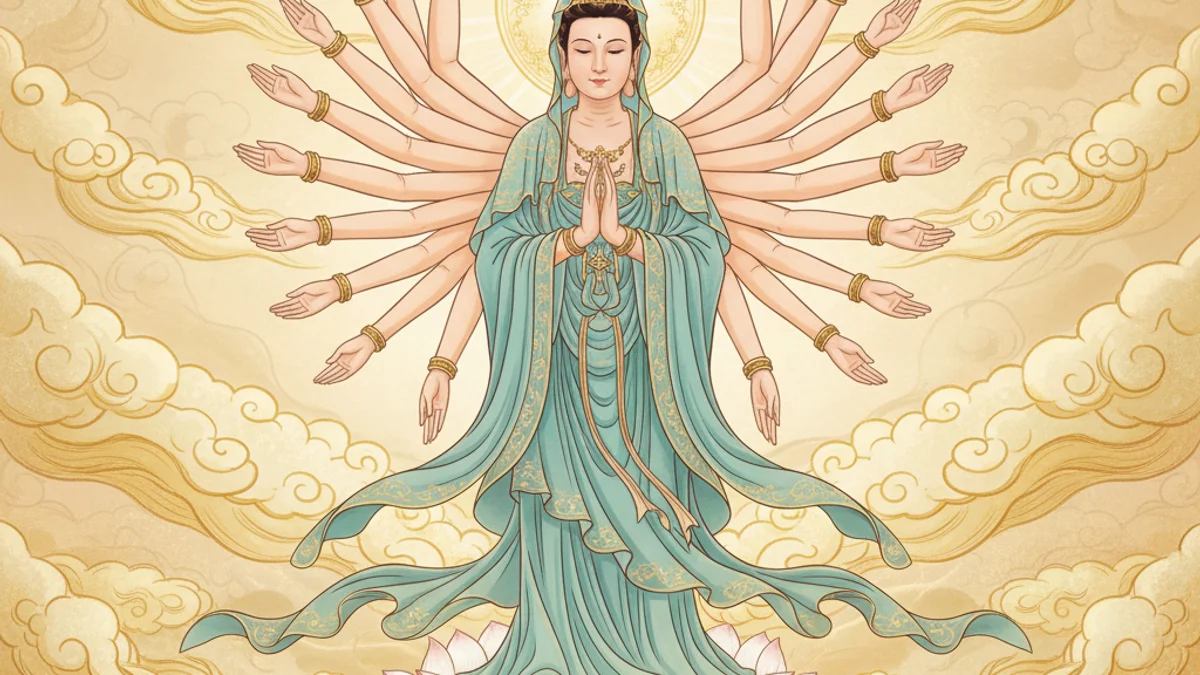
Long ago, the Princess Miao Shan lived a life of quiet devotion, refusing the riches and marriages her father, King Miao Zhuang, demanded. Despite her father’s cruelty—even an attempt on her life—she remained steadfast in her vow to alleviate the world's suffering. Upon her death, she descended into the underworld, but her pure presence turned the dark realm into a flowering paradise. Released back to the world of the living, she meditated on Fragrant Mountain until she attained enlightenment. When her father fell deathly ill with a disease no physician could cure, an unknown monk told him only an ointment made from the eyes and arms of one 'without anger' could save him. Guanyin, hearing of her father’s plight, sacrificed her own eyes and arms to heal him. Transformed by her infinite sacrifice, she ascended as the Thousand-Armed, Thousand-Eyed Bodhisattva, vowing to remain in the earthly realm until every soul is liberated from pain.
True compassion requires the willingness to sacrifice oneself for the well-being of others, even those who have wronged us.
Questions about this story
What is the moral of Guanyin's Compassion?
The story teaches that unconditional compassion and forgiveness have the power to transform even the most hardened hearts. It emphasizes putting the needs of others above one's own comfort or physical form.
Why does Guanyin have a thousand arms and eyes?
According to legend, the thousand arms allow her to reach out to help many people simultaneously, while the eyes in her palms signify her ability to see the suffering of every soul in the universe.
Who was Princess Miao Shan?
Miao Shan is considered the human incarnation of Guanyin. She was a princess who chose a life of spiritual devotion over royal luxury, eventually sacrificing her body to save her father.
Is Guanyin a god or a goddess?
In Chinese folklore, Guanyin is the Bodhisattva of Compassion. While originally depicted as male in early Buddhism (Avalokiteshvara), she is almost universally worshipped as a female figure in East Asia.
Advertisement


Good night.
