
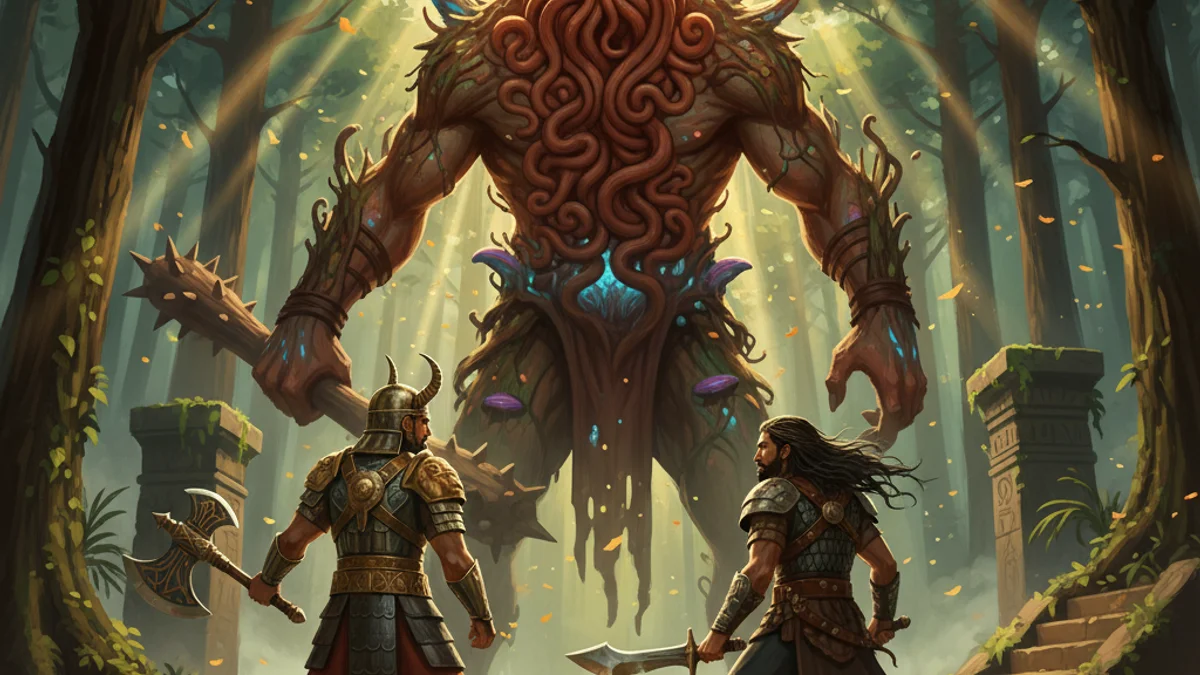
Gilgamesh, the mighty King of Uruk, grew restless and sought to carve his name into the annals of history. He proposed a perilous quest to his companion Enkidu: they would journey to the sacred Cedar Forest and slay its guardian, the monstrous Humbaba, to rid the world of evil and gain eternal fame. Despite Enkidu’s warnings of the creature’s terrifying power, the two friends set out. With the aid of the sun god Shamash, who sent thirteen great winds to paralyze the giant, Gilgamesh and Enkidu cornered the beast. Humbaba pleaded for his life, promising to serve Gilgamesh and give him the forest’s riches. However, Enkidu, fearing the giant's treachery and the gods' eventual interference, urged Gilgamesh to strike. They slew Humbaba and felled the magnificent cedars, returning to Uruk in triumph. Yet, their victory was bittersweet, as the slaughter of a divine guardian would soon bring the wrath of the gods upon them.
The pursuit of eternal fame through violence can lead to unforeseen consequences and the loss of what we value most.
Questions about this story
What is the moral of Gilgamesh and Humbaba?
The moral focuses on the dangers of hubris and the cost of seeking immortality through glory. While the heroes achieve their goal, their defiance of the gods leads to tragic consequences for Enkidu.
Who was Humbaba in Mesopotamian mythology?
Humbaba was the monstrous giant appointed by the god Enlil to guard the sacred Cedar Forest. He was known for his terrifying roar and his ability to see great distances.
Why did Gilgamesh want to kill Humbaba?
Gilgamesh sought to establish an everlasting reputation and prove his greatness. By killing a monster feared by all, he believed his name would live on forever in human memory.
How did Gilgamesh and Enkidu defeat Humbaba?
The sun god Shamash assisted the heroes by unleashing thirteen powerful winds that pinned Humbaba down. This allowed Gilgamesh and Enkidu to overcome the guardian's magical defenses.
Advertisement

Good night.
