
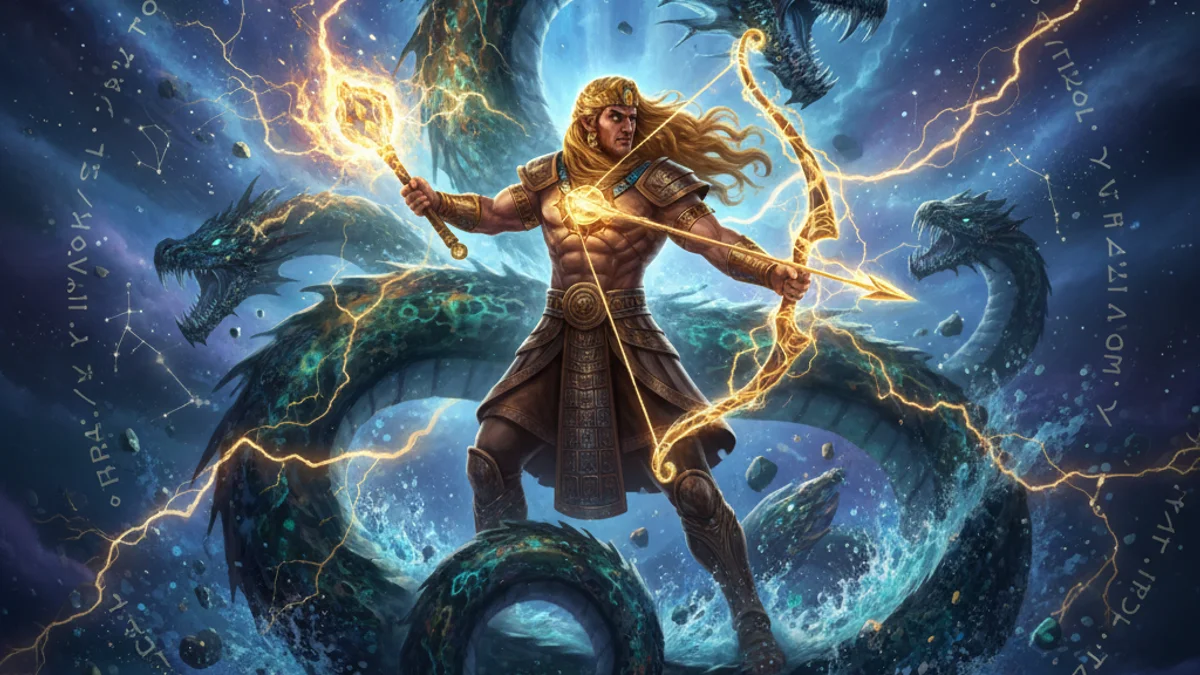
Before the world had a name, only the primordial waters existed: Apsu, the fresh water, and Tiamat, the salt ocean. Their union birthed the gods, whose boisterousness eventually disturbed Apsu’s rest. When Apsu plotted to destroy his children, the wise god Ea slew him. Tiamat, enraged and grieving, birthed a legion of monsters led by Kingu to exact revenge. The younger gods trembled until Marduk, son of Ea, stepped forward. He demanded supreme authority in exchange for facing the chaos. Armed with the four winds and a mighty bow, Marduk confronted Tiamat, who had taken the form of a terrifying dragon. He loosed an arrow into her gaping maw, slaying her. Marduk then split Tiamat’s body: one half became the sky, the other the earth. From the blood of the traitor Kingu, Marduk fashioned humanity to labor for the gods, establishing Babylon as the center of a new, ordered universe.
The triumph of order over chaos requires courage, wisdom, and the willingness to take responsibility for the collective good.
Questions about this story
What is the moral of Enuma Elish the Creation Epic?
It illustrates that civilization and order are achieved through the mastery of chaotic forces. It highlights the transition from primal nature to structured society led by a righteous king.
Who is the main hero of the Enuma Elish?
Marduk is the central hero who rises to power by defeating Tiamat. He is granted the fifty names and supreme kingship by the other gods for his bravery and leadership.
How was the world created in this myth?
The world was formed from the remains of the goddess Tiamat after she was defeated by Marduk. Her body was split to create the heavens and the earth, while her tears formed the Tigris and Euphrates rivers.
Why did Tiamat want to destroy the younger gods?
Tiamat initially protected her children, but after her consort Apsu was killed by the god Ea, she was spurred to vengeance. She raised an army of monsters to wipe out the younger generation of gods.
Advertisement
Good night.
