
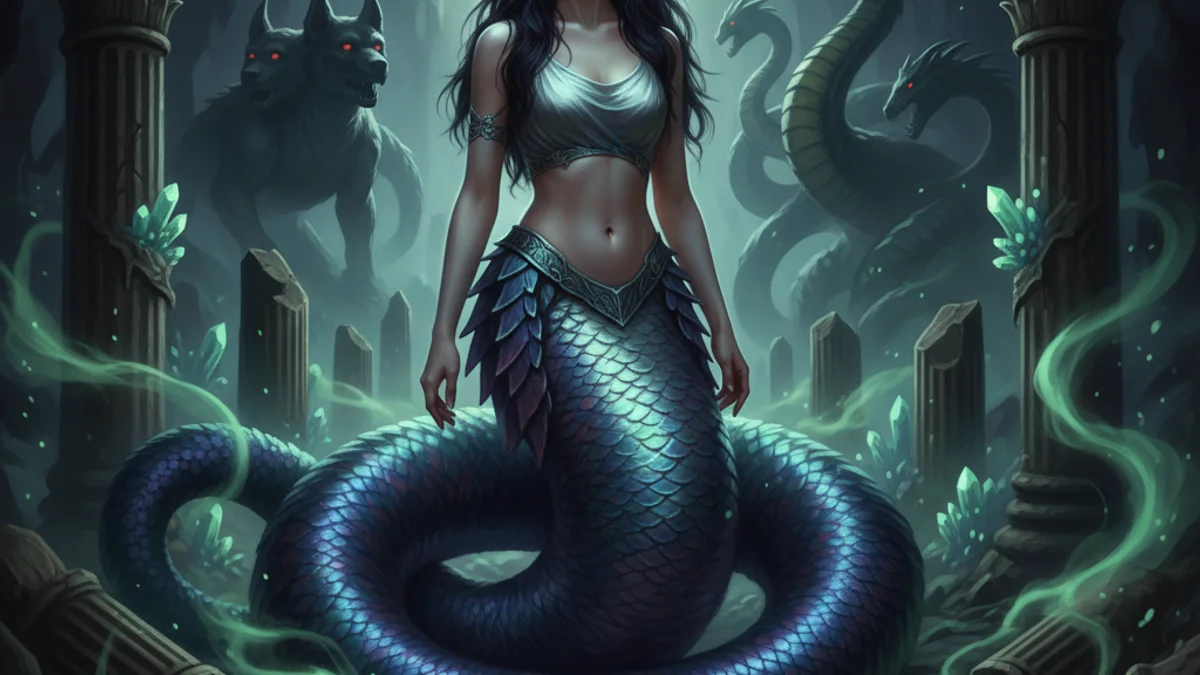
Deep beneath the earth in the hollows of Arima lived Echidna, a creature of dual nature. From the waist up, she was a fair-faced nymph with glimmering eyes and a seductive grace; below, she was a colossal, speckled serpent, fierce, fast, and insatiable. She was the mate of the storm-giant Typhon, and together they became the progenitors of all that is terrible in the world. From her womb came the three-headed Cerberus who guarded the gates of Hades, the multi-headed Lernaean Hydra, the fire-breathing Chimera, and the riddle-loving Sphinx. While her monstrous children were often hunted and slain by heroes like Heracles and Bellerophon, Echidna herself represented the primordial and indestructible force of chaos. She dwelled in her cave, feasting on the unwary, a timeless reminder that beauty can often mask a deadly and venomous heart.
Evil and chaos often leave a lasting legacy through the destruction their descendants cause, proving that one's influence outlives their physical presence.
Advertisement
Questions about this story
What is the moral of Echidna Mother of Monsters?
The story suggests that darkness and chaos have a way of propagating themselves through generations. It warns that even the most beautiful facades can hide a predatory nature that breeds destruction.
Who was the husband of Echidna?
Echidna was the mate of Typhon, the deadliest creature in Greek mythology and the youngest son of Gaea and Tartarus. Together, they were considered the ultimate power couple of the monster world.
Which famous monsters were the children of Echidna?
Echidna gave birth to a menagerie of terrors including Cerberus, the Hydra, the Chimera, the Sphinx, and the Nemean Lion. Most of these creatures served as legendary obstacles for heroes like Heracles.
How did Echidna die according to myth?
While Hesiod claimed she was immortal, other legends say she was killed in her sleep by Argus Panoptes, the hundred-eyed giant. He slew her to protect travelers from her predatory hunger.
Advertisement

