
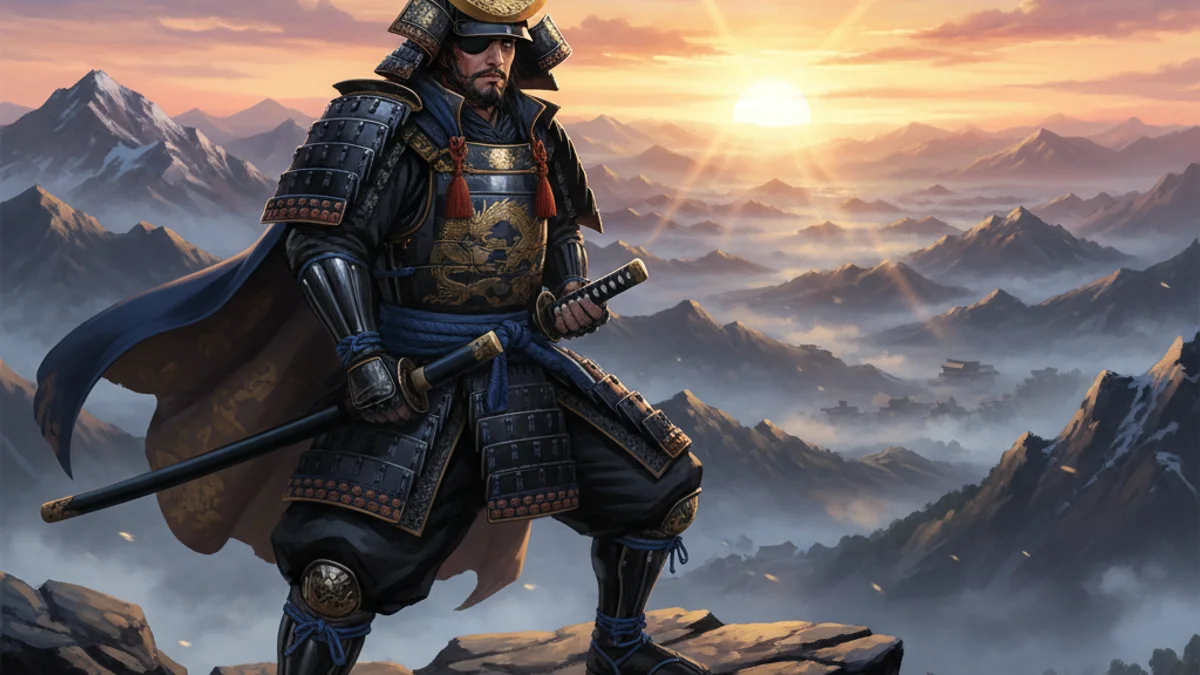
In the late 16th century, a boy named Bontenmaru was born to the Date clan in northern Japan. Disaster struck early when smallpox claimed his right eye, leaving him physically scarred and emotionally isolated. Rumors swirled that he was cursed, but the boy possessed a spirit that would not be broken. Upon coming of age, he took the name Date Masamune and set out to prove his worth. Clad in black armor and a helmet crowned with a massive golden crescent moon, he became a terrifying force on the battlefield. Known as the 'One-Eyed Dragon,' Masamune was a brilliant tactician who unified the warring factions of the north. Despite his reputation for ruthlessness, he was also a visionary statesman who founded the city of Sendai, encouraged international trade, and patronized the arts. He famously lamented that he was born too late to challenge the Great Unifiers for control of all Japan, yet his legacy as a symbol of resilience and bold leadership remains etched in history.
True strength is not found in physical perfection, but in the will to overcome personal tragedy and lead others with vision.
Questions about this story
What is the moral of Date Masamune the One-Eyed Dragon?
The story teaches that physical setbacks do not limit a person's potential for greatness. It emphasizes that resilience, ambition, and a strong vision can turn an apparent weakness into a legendary strength.
Why was Date Masamune called the One-Eyed Dragon?
He earned the nickname 'Dokuganryu' because he lost his right eye to smallpox as a child. Despite this, he became one of the most feared and respected military commanders in Japanese history.
What is the meaning of the crescent moon on his helmet?
The large, asymmetrical gold crescent moon served as his distinctive crest, symbolizing his bold personality and making him instantly recognizable on the battlefield. It has since become an iconic symbol of samurai culture.
Was Date Masamune a real historical figure?
Yes, he was a powerful daimyo (feudal lord) of the Azuchi-Momoyama period through early Edo period. He is historically credited with founding the city of Sendai and expanding trade with foreign nations.
Advertisement
Good night.
