
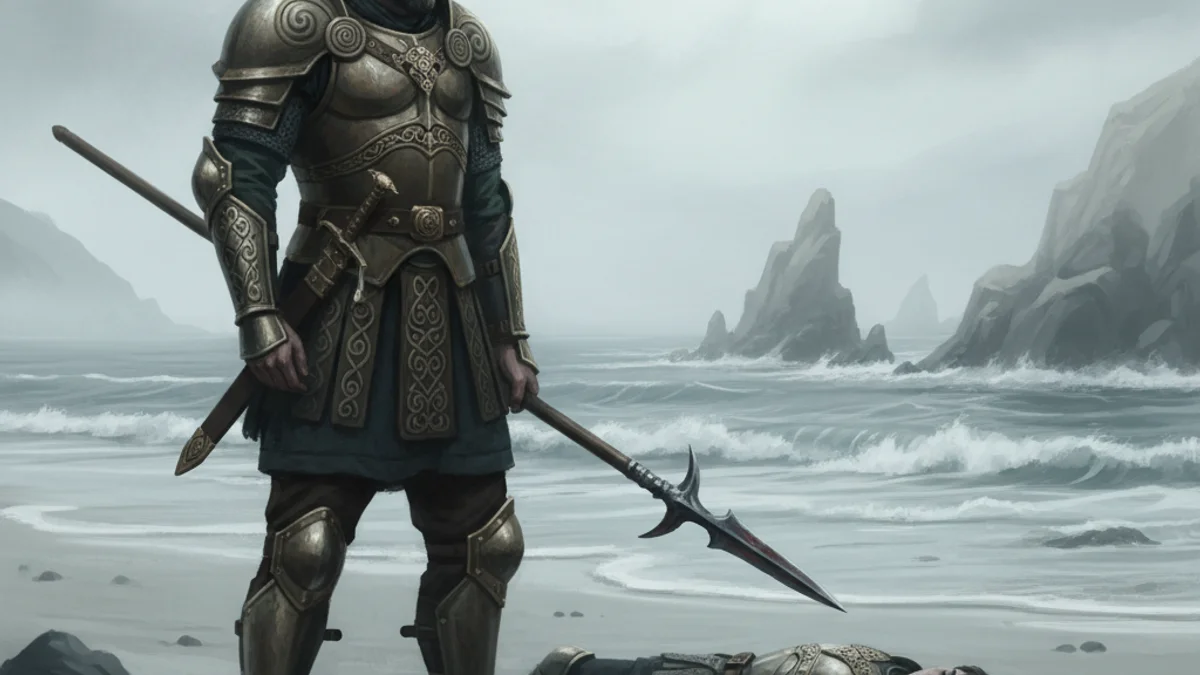
During his training with the warrior-woman Scáthach in Scotland, the Irish hero Cú Chulainn had a son with the rival queen Aoife. Before returning to Ulster, he left a gold ring for the boy and set three strict geasa: he must never reveal his name to any man, never turn back from his journey, and never refuse a challenge. Years later, the boy, Connla, arrived on the shores of Ireland. When King Conchobar’s warriors demanded his name, he refused, leading to a series of duels where the youth easily bested Ulster’s finest. Cú Chulainn, despite his wife Emer’s premonition that the boy was his own kin, went to defend the province’s honor. In the heat of battle, Connla intentionally aimed his spear away from his father, but Cú Chulainn, consumed by battle-fury, struck the boy with the lethal Gáe Bulg. As Connla lay dying, Cú Chulainn recognized the ring on his finger. Overwhelmed by grief, he realized he had slain the one person who could have carried his legacy, leaving him the last of his line.
Rigid adherence to pride and duty over intuition and communication can lead to irreparable personal tragedy.
Questions about this story
What is the moral of Cú Chulainn and Connla?
The story warns that rigid adherence to codes of honor and pride can lead to irreparable loss. It highlights how the refusal to communicate and the weight of ancient oaths can destroy what we value most.
Why did Connla refuse to tell his name?
Connla was bound by a geis, a magical taboo or solemn vow, placed upon him by his father at birth. This oath forbade him from revealing his identity, turning back from a path, or refusing a challenge.
Who was Connla's mother?
Connla’s mother was Aoife, a powerful Scottish warrior-queen who was once a rival to Scáthach. She raised Connla alone after Cú Chulainn returned to Ireland to serve King Conchobar.
What weapon did Cú Chulainn use to kill Connla?
He used the Gáe Bulg, a legendary notched spear that could only be thrown with the feet. Once it entered the body, it would sprout thirty barbs, making it impossible to remove without killing the victim.
Advertisement
Good night.
