
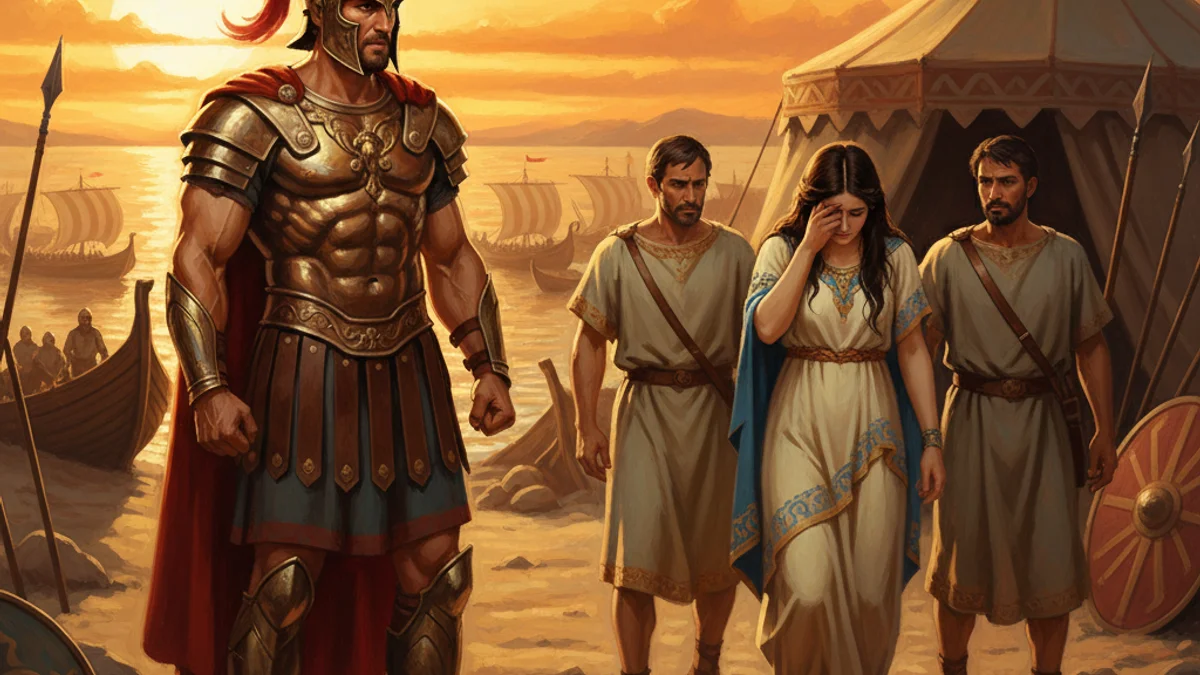
During the long siege of Troy, the legendary Greek hero Achilles claimed Briseis, a noblewoman of Lyrnessus, as his prize of honor. Despite the circumstances of her capture, a genuine bond of affection formed between them. However, tension erupted when King Agamemnon, the leader of the Greek forces, was forced to return his own captive to stop a divine plague. To assert his dominance, Agamemnon demanded Briseis as compensation. Achilles, feeling his honor stripped away alongside his companion, surrendered her but withdrew from the war in a fit of righteous rage. He sat in his tent while the Trojans pushed the Greeks back to their ships. This singular dispute over Briseis became the catalyst for the greatest tragedies of the Trojan War, leading to the death of Patroclus and, eventually, Achilles himself, proving that the pride of leaders often costs the lives of the innocent.
Unchecked pride and the treatment of people as pawns in a power struggle can lead to catastrophic consequences for everyone involved.
Questions about this story
What is the moral of Briseis and Achilles?
The story illustrates how the ego and pride of powerful men can cause immense suffering for others. It serves as a warning that treating people as property leads to resentment and social collapse.
Why did Agamemnon take Briseis from Achilles?
Agamemnon was forced to return his own war prize, Chryseis, to her father to appease the god Apollo. To maintain his status and spite Achilles, he exercised his royal authority to seize Briseis instead.
Did Achilles actually love Briseis?
While she began as a war prize, the Iliad suggests a deeper connection; Achilles refers to her as the 'bride of his heart' and is devastated by her loss. Their relationship represents one of the few glimpses of vulnerability in the hero.
How did the dispute over Briseis change the Trojan War?
The conflict caused Achilles to withdraw his support from the Greek army. Without their greatest warrior, the Greeks suffered massive losses, which directly led to Patroclus taking Achilles' place and being killed by Hector.
Advertisement

Good night.
