
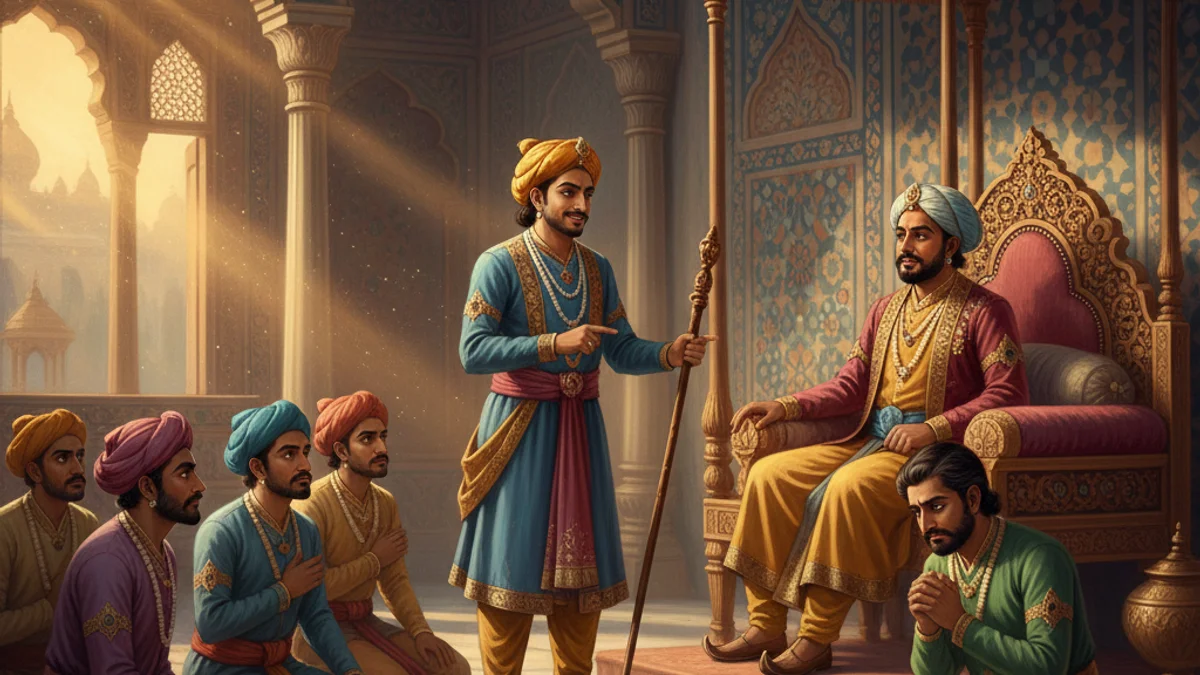
A wealthy merchant once approached Emperor Akbar, distressed because his house had been burgled and his precious jewels stolen. Suspecting that one of his own servants was the culprit, Akbar tasked Birbal with finding the thief. Birbal summoned all the servants and handed each a wooden stick of equal length. 'These are magic sticks,' he declared. 'By tomorrow morning, the thief’s stick will grow exactly two inches longer.' The servants were dismissed and told to return the next day. Terrified of being caught, the real thief stayed awake that night. Believing the 'magic' would surely work, he cut exactly two inches off his stick, thinking it would then appear to be the original length in the morning. When the servants gathered the next day, Birbal inspected the sticks and immediately identified the thief whose stick was two inches shorter than the rest. The thief fell at Birbal's feet and confessed, realizing that his own fear had betrayed him.
Guilt always finds a way to reveal itself, and a clear conscience remains untroubled.
Questions about this story
What is the moral of Birbal Catches the Thief?
The moral is that guilt is a powerful force that often leads a criminal to make mistakes. It demonstrates that those who have done wrong will eventually expose themselves through their own fear and anxiety.
How did Birbal identify the thief?
Birbal used a psychological trick by telling the servants that a magic stick would grow. The thief, believing this lie, cut his stick shorter to compensate for the imagined growth, thereby identifying himself.
Did the sticks in the story actually have magic powers?
No, the sticks were ordinary wooden sticks. Birbal relied on the thief's guilty conscience and lack of scientific knowledge to provoke a reaction that would reveal the truth.
Why did Akbar always rely on Birbal for such cases?
Birbal was one of the 'Navratnas' or Nine Gems of Akbar's court. He was celebrated for his extraordinary wit, wisdom, and his ability to solve complex problems through logic rather than force.
Advertisement
Good night.
