
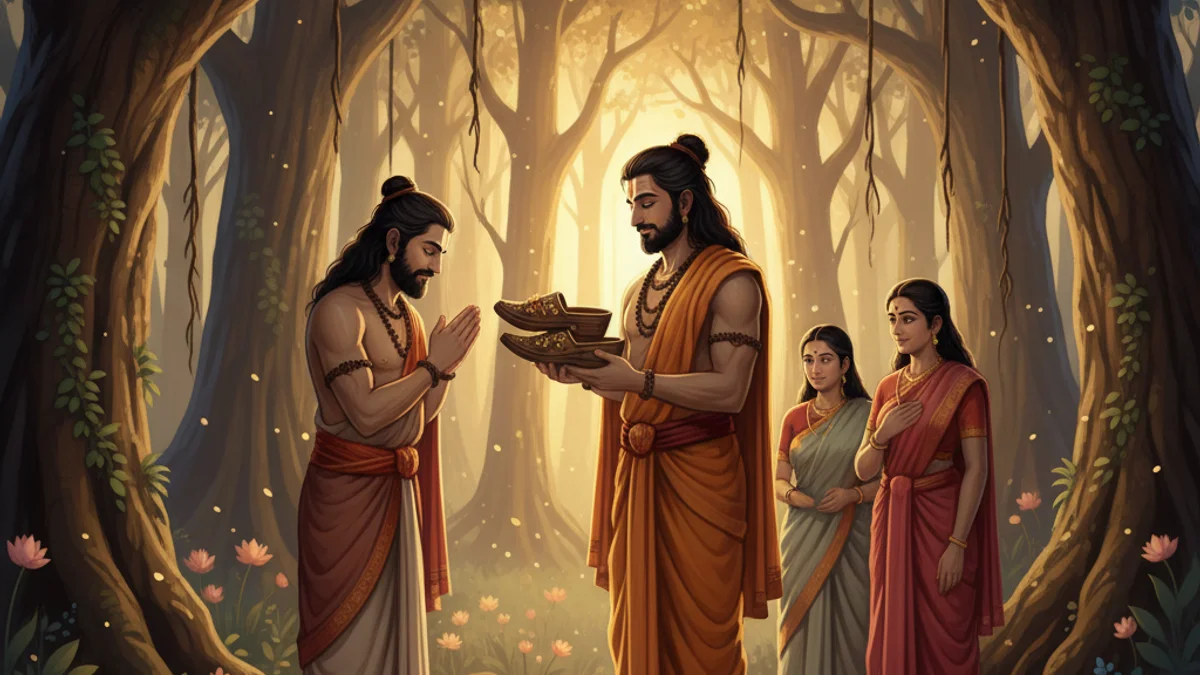
When Prince Bharata returned to Ayodhya, he was devastated to find his father dead and his brother Rama exiled. Rejecting the crown his mother Kaikeyi had secured through deceit, Bharata tracked Rama to the forest of Chitrakoot. He pleaded with Rama to return and rule, but Rama, committed to upholding his father’s vow, refused. Realizing Rama would not break his word, Bharata requested Rama’s wooden sandals, known as Padukas. Placing them reverently upon his head, Bharata vowed to live as an ascetic outside the city in Nandigram. For fourteen years, the sandals sat upon the throne of Ayodhya, symbolizing Rama’s rightful sovereignty while Bharata served merely as a devoted regent, awaiting his brother’s return.
True leadership is found in selfless service, and devotion to righteousness outweighs the allure of power.
Questions about this story
What is the moral of Bharata's Sandals?
It teaches that duty and devotion are more important than personal ambition. Bharata's refusal to take the throne shows his integrity and love for his brother Rama.
Why did Bharata place the sandals on the throne?
He placed the sandals on the throne to symbolize that Rama was the true king of Ayodhya. Bharata acted only as a caretaker or regent until Rama's return from exile.
Where did Bharata live during Rama's exile?
Bharata lived in a small village called Nandigram, located on the outskirts of Ayodhya. He lived the life of an ascetic, mirroring the hardships Rama faced in the forest.
Who gave the throne to Bharata?
Queen Kaikeyi, Bharata's mother, used two boons from King Dasharatha to secure the throne for her son and send Rama into exile. However, Bharata rejected her actions.
Advertisement
Good night.
