
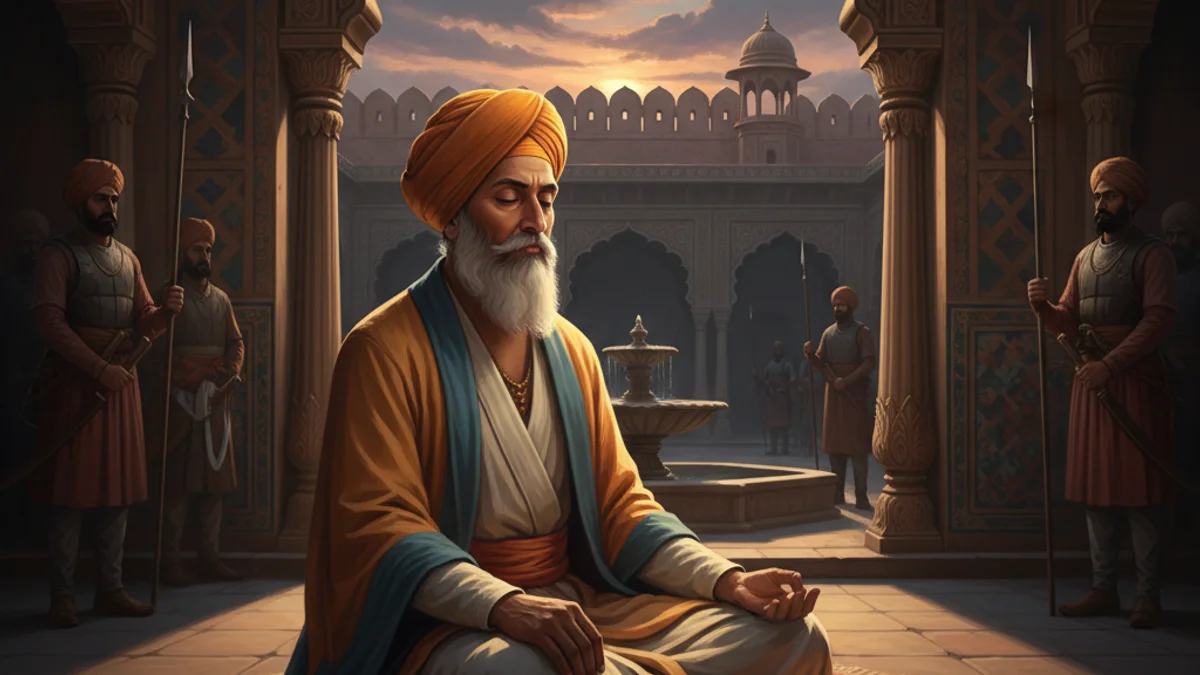
In 1737, Bhai Mani Singh, the revered head granthi of the Golden Temple and a childhood companion of Guru Gobind Singh, sought permission from Zakariya Khan, the Mughal Governor of Lahore, to hold a Sikh gathering during Diwali. The Governor agreed on the condition that a tax of 5,000 rupees be paid to the state. However, the Governor secretly planned to trap and massacre the Sikhs who gathered. Sensing the treachery, Bhai Mani Singh sent word to the community to avoid the gathering. Because no one arrived, no tax could be collected. Zakariya Khan used this as a pretext to arrest Bhai Mani Singh, demanding he either pay the tax or convert to Islam. Bhai Mani Singh refused both, choosing to stand by his faith. The Qazi ordered him to be executed by 'Band Band Katna'—cutting his body apart joint by joint. As the executioner began at the wrist, Bhai Mani Singh calmly reminded him to follow the order strictly and start from the finger joints. He remained in deep prayer until his last breath, showing the world that a true devotee’s spirit can never be broken by physical torture.
True faith is unshakeable; one must remain committed to their principles and devotion even in the face of the ultimate sacrifice.
Questions about this story
Why was Bhai Mani Singh executed?
He was executed because he refused to pay an unfair tax imposed by the Mughal Governor and refused to renounce his Sikh faith and convert to Islam.
What does the term 'Band Band Katna' mean?
It translates to 'cutting joint by joint.' It was a brutal form of execution where the body was dismembered at every skeletal joint starting from the fingers.
Who was the Mughal Governor responsible for his death?
Zakariya Khan was the Governor of Lahore who ordered the arrest and execution of Bhai Mani Singh after a failed attempt to entrap the Sikh community.
What was Bhai Mani Singh's role in Sikh history?
He was a scholar, a scribe who wrote the final version of the Guru Granth Sahib, and the head priest (Granthi) of the Harmandir Sahib.
Advertisement
Good night.
