
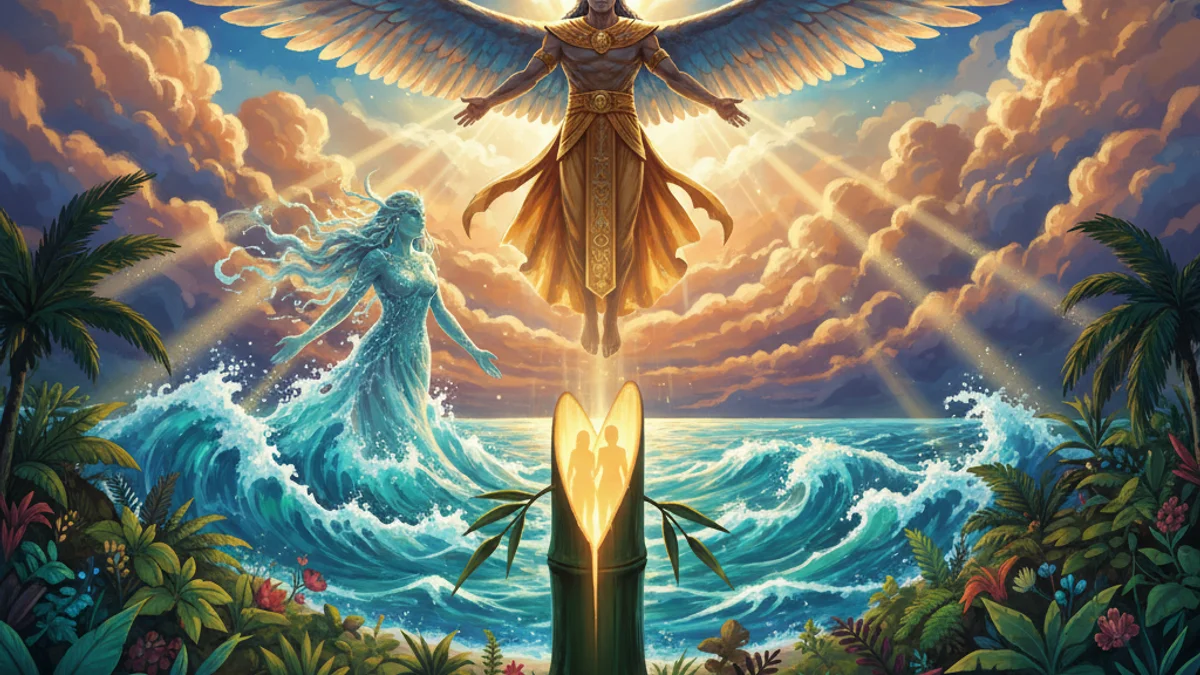
In the beginning, the universe was a void shared by three powerful deities: Bathala, the ruler of the sky; Aman Sinaya, the goddess of the sea; and Amihan, the north wind. For eons, the sky and sea were locked in a fierce rivalry for dominance. Aman Sinaya sent great tempests upward, and Bathala retaliated by hurling massive boulders into the water. These boulders eventually broke the waves and became the thousands of islands that form the archipelago. Tired of the eternal conflict, the wind, Amihan, flew between them until the two deities finally reached a truce. Upon one of the newly formed islands, a giant bamboo stalk grew from the earth. A divine bird pecked at the stalk until it split into two halves. From the first half stepped Malakas, the first man, and from the second stepped Maganda, the first woman. Bathala looked upon them with favor and blessed the land, giving rise to the people of the Philippines.
Harmony and balance between opposing forces are necessary for the creation and sustenance of life.
Questions about this story
What is the moral of Bathala Creates the World?
The story teaches that creation arises from the resolution of conflict and the balance of nature. It emphasizes that peace between powerful forces is essential for life to flourish and thrive.
Who are the three primordial deities in the myth?
The three original deities are Bathala, the sky god; Aman Sinaya, the sea goddess; and Amihan, the personified north wind. They existed before the physical world was shaped.
How were the first humans created in Filipino mythology?
The first humans, Malakas and Maganda, emerged from a giant bamboo stalk that was pecked open by a divine bird. This symbolizes the close connection between humanity and nature.
What do the names Malakas and Maganda mean?
In Filipino, Malakas means 'Strong' and Maganda means 'Beautiful.' Together, they represent the ideal characteristics of the first man and woman.
Advertisement
Good night.
