
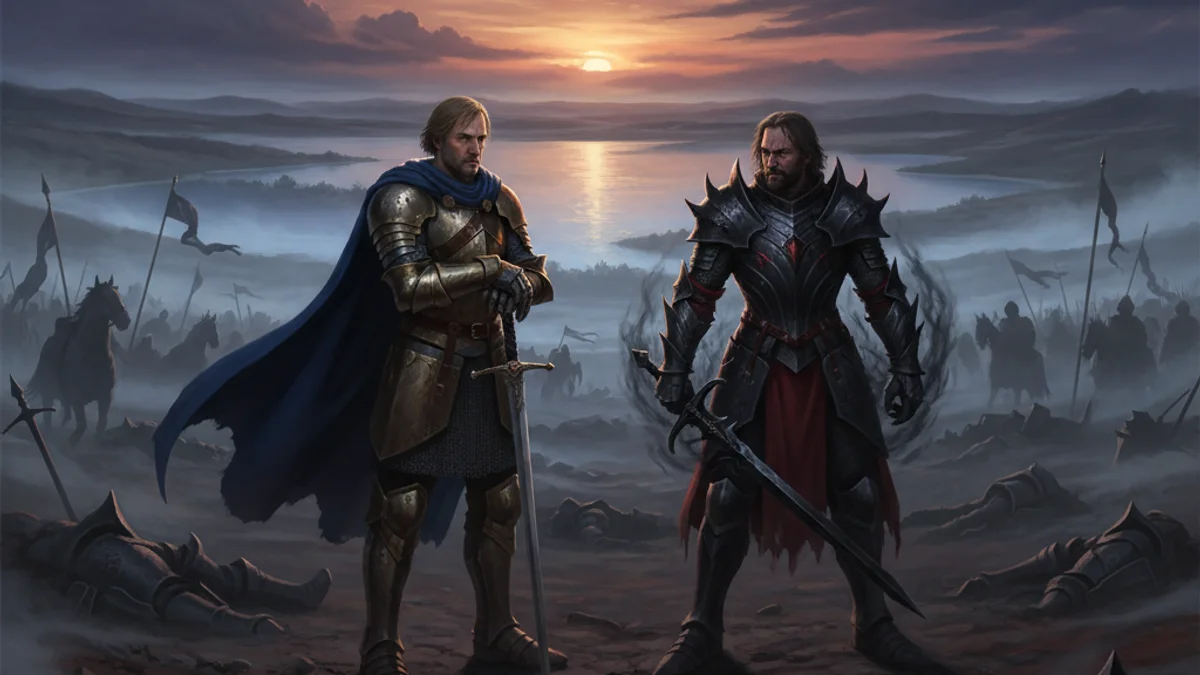
The golden age of Camelot met its tragic end on the misty fields of Camlann. King Arthur, betrayed by his own son Mordred, led his remaining knights into a desperate final conflict. As the sun began to set over a field of fallen heroes, only Arthur and Mordred remained standing. In a final, weary exchange of blows, Arthur pierced Mordred with his spear, but as the traitor fell, he dealt the King a mortal wound to the head. The dying King was carried from the field by Sir Bedivere, the last of his loyal companions. Arthur commanded Bedivere to cast the sword Excalibur into the nearby lake. Twice the knight hesitated, enchanted by the blade’s beauty, but on the third attempt, he threw it far into the water. A mysterious arm clad in white samite rose from the depths, caught the sword, and vanished. Soon after, a black barge appeared to carry Arthur away to the mystical isle of Avalon, leaving behind a legacy of a kingdom that once was and a promise of a king who might one day return.
The fall of a great leader reminds us that while physical power and kingdoms are fleeting, the ideals of honor and the hope of renewal are immortal.
Questions about this story
What is the moral of Arthur's Final Battle?
The moral is that even the greatest eras must come to an end, but the legend and values of a true hero endure forever. It emphasizes that legacy is built on honor and sacrifice rather than just victory.
Who was King Arthur's opponent in his final battle?
Arthur fought against Mordred, who is often depicted as his nephew or illegitimate son. Mordred betrayed Arthur by seizing the throne while the King was away, leading to the civil war at Camlann.
What happened to the sword Excalibur?
Following Arthur's command, Sir Bedivere threw Excalibur into a mystical lake. The Lady of the Lake's arm rose from the water, caught the sword, and pulled it beneath the surface.
Where was King Arthur taken after he was wounded?
Arthur was placed on a magical barge by three queens and taken to the Isle of Avalon. It is a mystical place where his wounds were meant to be healed.
Advertisement
Good night.
