
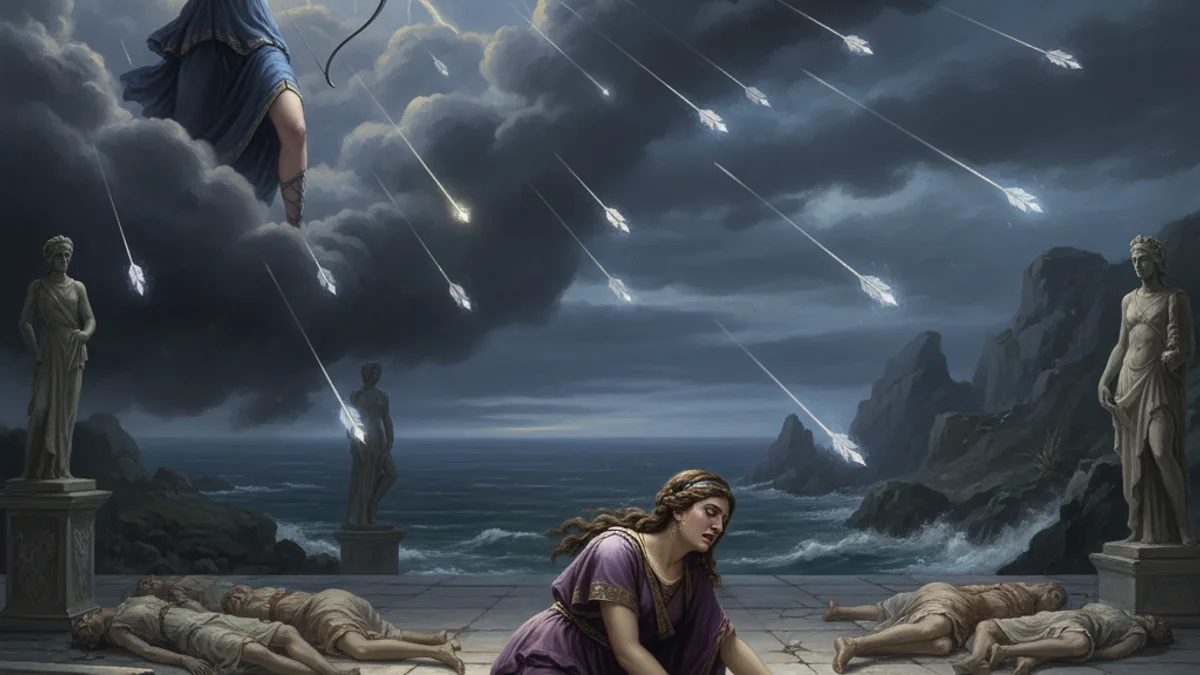
Queen Niobe of Thebes was a woman of immense pride, blessed with fourteen beautiful children—seven sons and seven daughters. During a festival honoring the titaness Leto, Niobe brazenly mocked the goddess, boasting that her own offspring were far superior to Leto’s only two children, Apollo and Artemis. Enraged by this insult to their mother, the divine twins descended from Olympus to exact a terrible vengeance. With lethal precision, Apollo struck down all seven of Niobe’s sons with his golden arrows, while Artemis took the lives of the seven daughters with her silver bow. Witnessing the sudden slaughter of her entire lineage, Niobe’s husband took his own life in despair. Niobe herself was paralyzed by grief, her heart hardening until she transformed into a pillar of stone on Mount Sipylus. Even as a statue, her sorrow remained eternal, as a natural spring continued to trickle from the rock like a never-ending stream of tears.
The myth warns against the dangers of hubris and the folly of comparing mortal achievements to the eternal power of the divine.
Questions about this story
What is the moral of Artemis and Niobe?
The moral is that hubris, or excessive pride, leads to ruin. It teaches that mortals should remain humble and avoid insulting or competing with the gods.
Why did Artemis and Apollo kill Niobe's children?
They sought to defend the honor of their mother, Leto, after Niobe publicly mocked her for only having two children while Niobe had fourteen.
What happened to Niobe at the end of the story?
Consumed by grief, Niobe fled to Mount Sipylus where she was transformed into a rock formation that appeared to weep as water seeped through it.
Who were the Niobids in Greek mythology?
The Niobids were the fourteen children of Queen Niobe and King Amphion of Thebes, consisting of seven sons and seven daughters.
Advertisement

Good night.
