
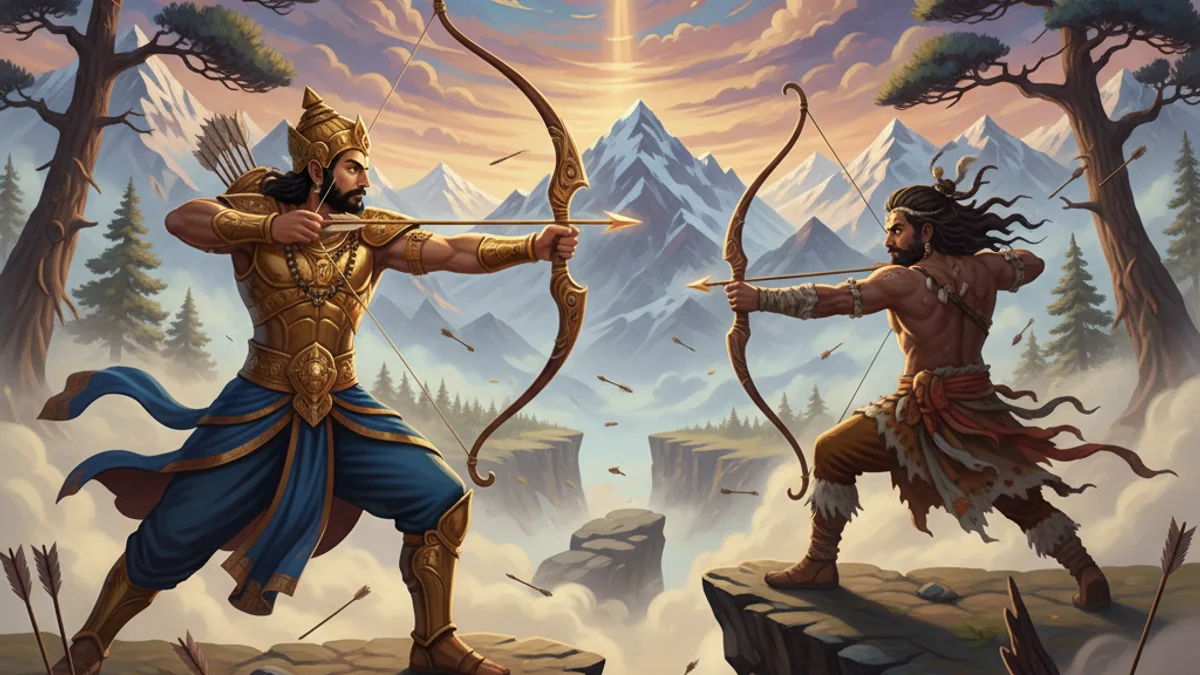
During the exile of the Pandavas, Arjuna journeyed to the Indrakeela mountains to perform rigorous penance to please Lord Shiva. His goal was to obtain the Pashupatastra, a celestial weapon needed for the impending war. As Arjuna meditated, a demon named Muka took the form of a wild boar to attack him. Arjuna fired an arrow at the beast, but simultaneously, a wild hunter, or Kirata, fired another. Both arrows struck at once. A dispute arose over who had the right to the kill, escalating into a fierce duel. Arjuna, the master archer, found his legendary Gandiva bow and inexhaustible quivers useless against the Kirata. Exhausted and humbled, Arjuna realized his opponent was no ordinary mortal. He fashioned a clay Lingam to worship Shiva, only to see the garland he offered manifest on the Kirata’s neck. Recognizing the Lord, Arjuna fell at his feet. Pleased with Arjuna's prowess and devotion, Shiva revealed his true form and granted him the divine weapon.
True strength is found in humility and devotion; even the greatest skill must bow before the divine.
Questions about this story
What is the moral of Arjuna and the Kirata?
The story teaches that skill alone is insufficient without humility and devotion. It highlights that even the greatest warriors must recognize the supremacy of the divine and remain steadfast in their goals.
Why did Lord Shiva disguise himself as a Kirata?
Shiva wanted to test Arjuna’s combat skills, endurance, and character before granting him a weapon of mass destruction. The disguise allowed him to engage in a physical trial without Arjuna immediately surrendering out of reverence.
What is the Pashupatastra?
The Pashupatastra is one of the most powerful celestial weapons in Hindu mythology, capable of destroying all creation. Arjuna sought it to ensure victory for the Pandavas in the upcoming Kurukshetra War.
Who was the wild boar in the story?
The boar was actually a demon named Muka, who intended to kill Arjuna while he was deep in meditation. Its death served as the catalyst for the conflict between Arjuna and the disguised Lord Shiva.
Advertisement
Good night.
