
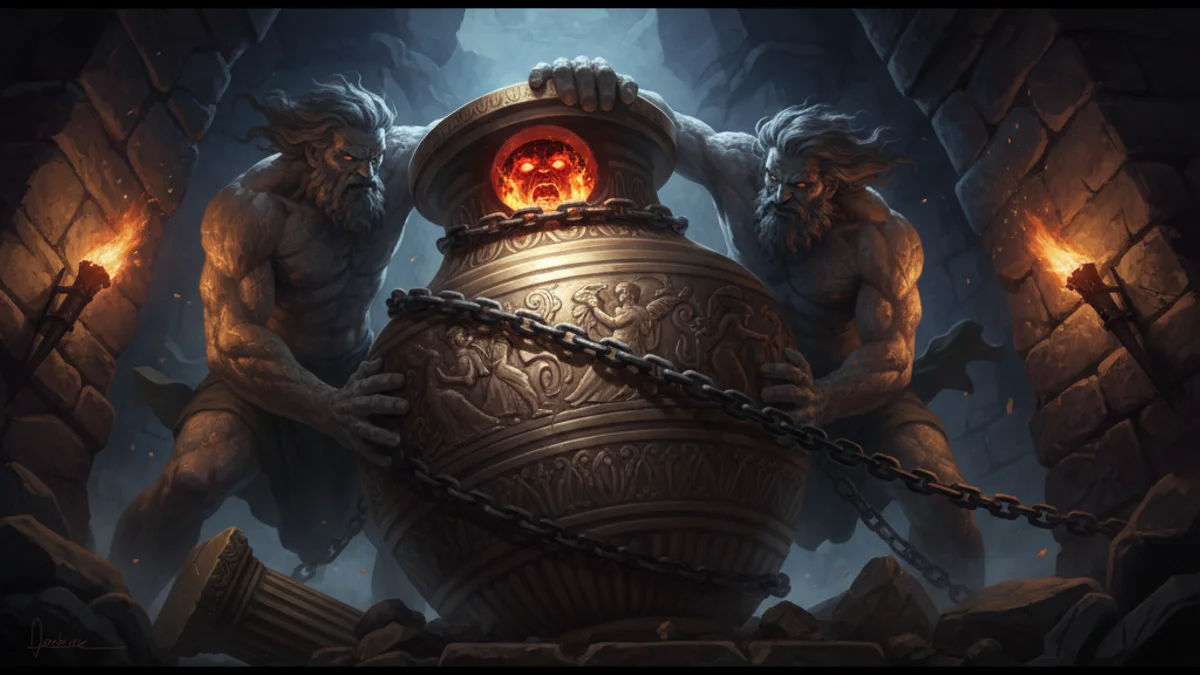
In their hubris, the twin giants Otis and Ephialtes, known as the Aloadae, sought to overthrow Mount Olympus. Their first act of defiance was the capture of Ares, the fierce god of war. Binding him with heavy chains of adamantine, they forced him into a massive bronze jar. For thirteen grueling months, the god languished in silence, his strength fading as the world suffered from a chaotic lack of martial order. The giants’ stepmother, Eriboea, eventually revealed Ares's location to Hermes. The messenger god moved like a shadow, surreptitiously breaking the seal and pulling a nearly dead Ares from his metallic prison. Though the god was freed, his dignity was shattered, proving that even the most violent force can be contained by cunning and hubris.
Brute strength and aggression are not invincible; even the most powerful can be humbled and restrained by those they underestimate.
Questions about this story
What is the moral of Ares Trapped in the Jar?
The story shows that unchecked aggression can be neutralized by unexpected means. It emphasizes that no one, not even a god, is beyond the reach of consequence or confinement.
Who trapped Ares in the bronze jar?
The twin giants Otis and Ephialtes, collectively known as the Aloadae, captured Ares. They were the sons of Poseidon and Iphimedia who grew to immense size and challenged the authority of the Olympian gods.
How long was Ares imprisoned in the jar?
Ares remained inside the bronze jar for thirteen lunar months. By the time he was rescued, he was nearly dead and completely exhausted from his long confinement without food or light.
How did Ares eventually escape the jar?
Hermes, the messenger god, rescued Ares after being informed of his location by Eriboea, the giants' stepmother. Hermes used his stealth and divine craft to free the god without alerting the giants.
Advertisement
Teach next

Good night.
