
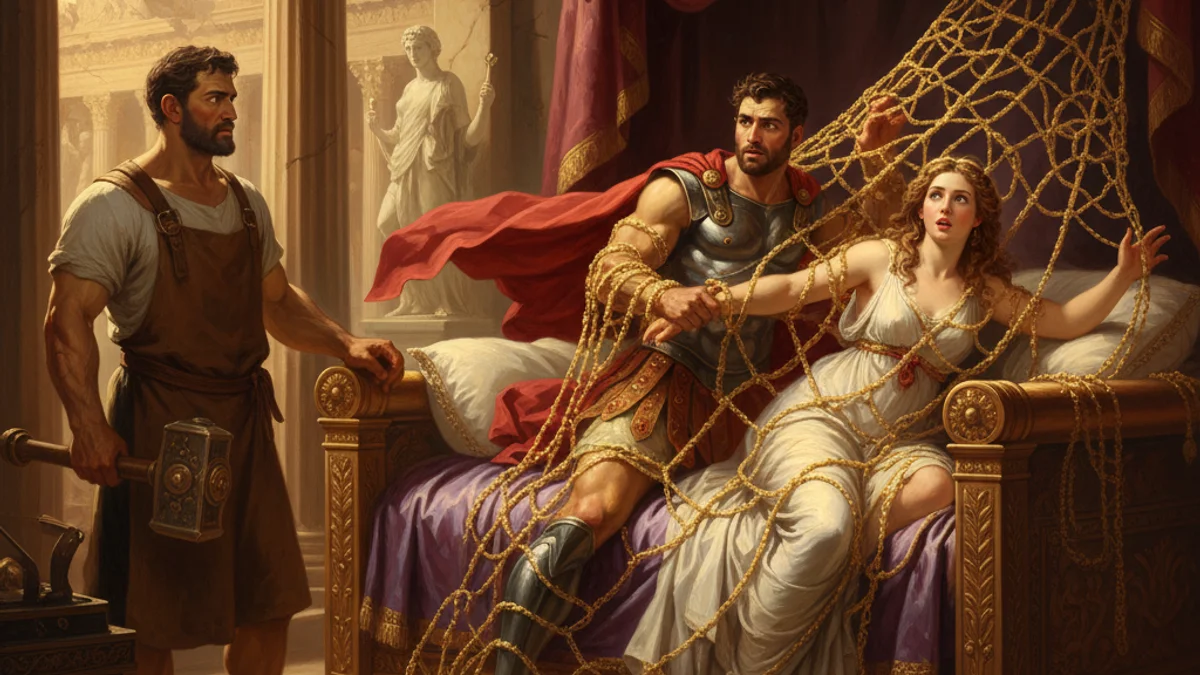
Aphrodite, the goddess of beauty, was married to Hephaestus, the smith-god who was often mocked for his appearance and limp. Seeking passion, Aphrodite began a secret affair with Ares, the god of war. Their trysts were hidden until Helios, the sun god, spotted them from his chariot and informed Hephaestus. Instead of reacting with rage, the master craftsman forged a net of bronze links so fine they were invisible, yet strong enough to hold a god. He draped the trap over his marriage bed and announced he was leaving for Lemnos. As soon as he departed, Ares joined Aphrodite. The moment they lay down, the net sprang, binding them tightly together. Hephaestus returned with the other Olympian gods to witness the scandal. While the goddesses stayed away out of modesty, the male gods roared with laughter at the sight of the mighty warrior and the queen of beauty caught in such a ridiculous snare. Hephaestus refused to release them until Ares paid the price for his adultery, a debt eventually guaranteed by Poseidon.
Deception and infidelity eventually come to light, and cleverness can often triumph over brute strength.
Questions about this story
What is the moral of Ares and Aphrodite?
The story warns that secrets are rarely kept forever and that cleverness can overcome even the strongest warriors. It highlights the consequences of infidelity and the public shame that follows.
Who caught Ares and Aphrodite together?
Helios, the sun god, witnessed the secret meetings from his high vantage point in the sky and informed Hephaestus. This led the smith-god to forge his unbreakable trap.
Why did Aphrodite have an affair with Ares?
Aphrodite was married to Hephaestus against her will and found him unattractive. She was drawn to Ares because of his physical beauty and fiery nature, representing the classic union of Love and War.
What was the golden net made of?
Hephaestus used his divine forging skills to create a net of bronze that was as thin as a spider's web but stronger than any metal. It was designed to be completely invisible to the naked eye.
Advertisement

Good night.
