Story Summary
Discover the classic tale of Donkeyskin, a princess who flees her father's kingdom in a beastly disguise to find true love and reclaim her royal identity.
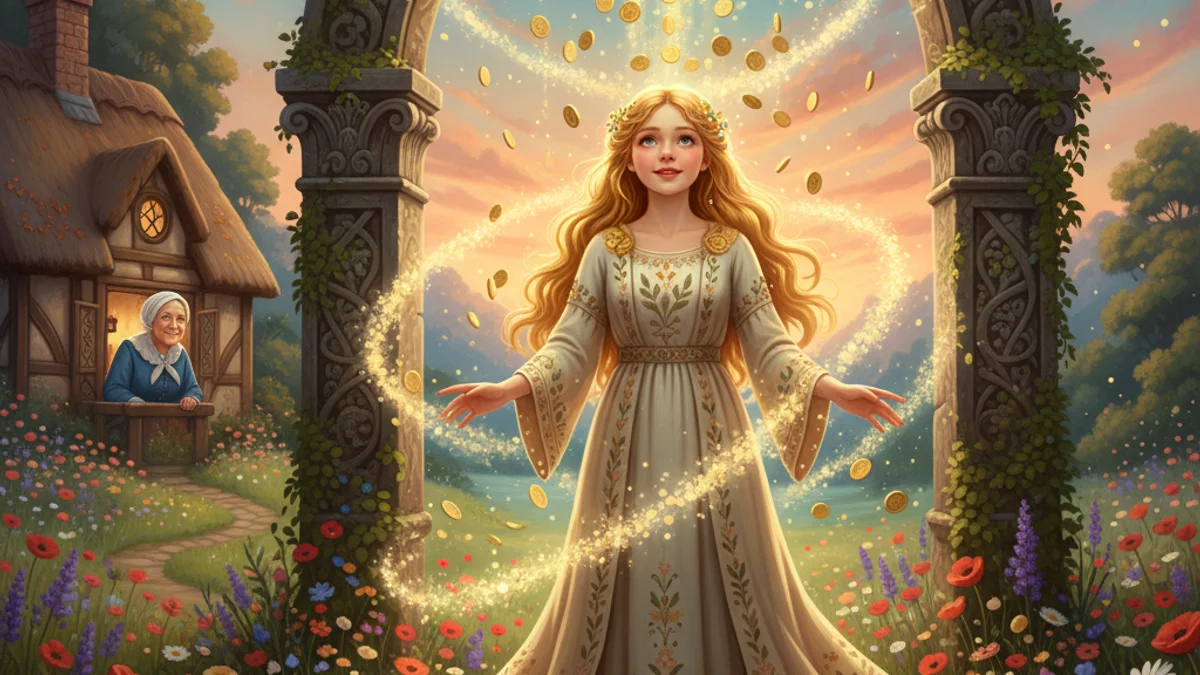
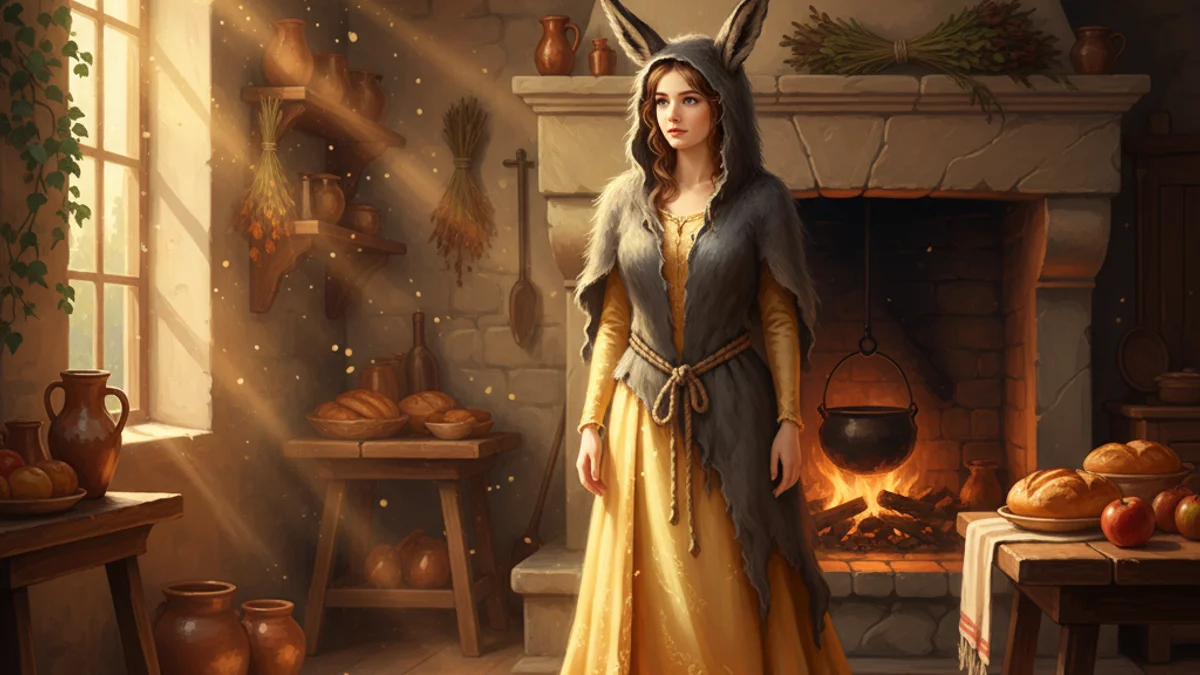
Once, a prosperous king owned a magical donkey that produced gold. When his beloved queen died, she made him promise only to remarry a woman more beautiful than her. In his grief-stricken madness, the king decided only his own daughter met this criteria. Distraught, the princess sought help from her fairy godmother, who advised her to ask for impossible gifts: dresses the color of the sky, the moon, and the sun. To her horror, the king provided them all. Finally, she asked for the skin of his prized golden donkey. When he sacrificed the animal for her, she fled the kingdom draped in the foul hide. She found work in a distant land as a lowly scullery maid, known only as 'Donkeyskin' for her wretched appearance. One day, a traveling prince glimpsed her in secret through a keyhole, wearing her sun-colored dress. He fell ill with love and demanded a cake baked by her. She hid a ring inside the batter. The prince then declared he would marry only the woman whose finger fit the ring. After every lady in the land failed, Donkeyskin tried it, the ring fit perfectly, and she was revealed in her royal splendor.
The Moral
True virtue and nobility cannot be hidden by a lowly exterior, and courage in the face of adversity eventually leads to happiness.
“Better to face the world in a donkey's skin than to lose one's soul in a palace.”
Fun Fact
Charles Perrault's Donkeyskin is considered one of the earliest examples of the 'Animal Bridegroom' or 'Catskin' folk motif, where a protagonist uses a skin to hide their beauty.
Frequently Asked Questions
What is the moral of Donkeyskin?
The moral is that inner worth and virtue remain intact despite outward appearances or humble circumstances. It also teaches that patience and resourcefulness can help one overcome even the most difficult family or social trials.
Who wrote the most famous version of Donkeyskin?
The most famous literary version was written by the French author Charles Perrault, published in 1694. It is often associated with his other Mother Goose tales like Cinderella and Sleeping Beauty.
Why did the princess wear a donkey's skin?
She used the foul-smelling hide as a disguise to escape her father's palace and to ensure no one would recognize her or find her attractive while she lived in exile. It served as a shield for her safety and identity.
What are the three dresses in the story?
The princess requests three seemingly impossible dresses: one the color of the sky (blue), one the color of the moon (silver), and one as bright as the sun (gold). These represent her royal status and celestial beauty.
How is Donkeyskin similar to Cinderella?
Both stories involve a persecuted heroine who works as a lowly servant, a magical helper (fairy godmother), a royal ball or secret sighting, and a 'test' of identity—a ring in Donkeyskin and a glass slipper in Cinderella.
What happened to the gold-producing donkey?
The king sacrificed his most prized possession, the donkey that provided his kingdom's wealth, to satisfy the princess's request for its skin. This showed the depth of his obsession and the princess's desperation to escape.