Story Summary
Discover the tale of The Goose Girl, a betrayed princess forced into servitude. Witness her journey to reclaim her crown and the fate of her deceptive maid.
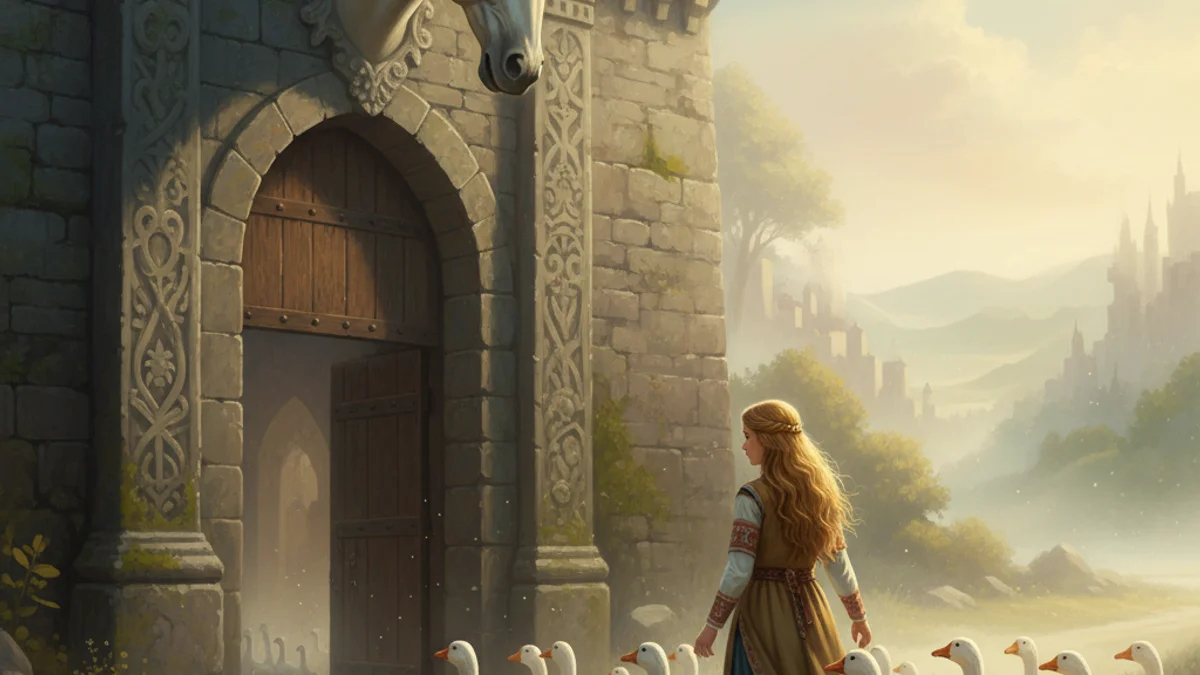
A widowed queen sent her daughter to a distant kingdom to marry a prince. For the journey, she gave the princess a talking horse named Falada and a handkerchief with three drops of her blood for protection. During the trip, a treacherous waiting-maid forced the princess to trade clothes and horses, threatening to kill her if she spoke of the switch. Having lost the handkerchief, the princess was defenseless. At the palace, the maid was welcomed as the bride, while the true princess was sent to herd geese with a boy named Conrad. The maid ordered Falada killed, but the princess had the horse’s head nailed to a dark gateway. Each day, she spoke to the head, which addressed her as a princess. Conrad, annoyed by the girl’s strange ways and her golden hair, complained to the old King. The King observed her, then invited her to share her sorrows into an iron stove. She whispered her truth, which the King overheard through the pipe. He dressed her in royal robes, revealed the maid’s treachery, and married her to the prince, while the imposter met a grim fate.
The Moral
Truth and innate nobility cannot be permanently hidden by deception or misfortune.
“O Falada, hanging there, that you should know of my despair!”
Fun Fact
The talking horse Falada is believed to be a remnant of ancient Germanic mythology, where horse heads were often used as protective charms or to ward off evil.
Frequently Asked Questions
What is the moral of The Goose Girl?
The story teaches that truth is an unstoppable force that will eventually come to light. It also emphasizes that true nobility is found in one's character and patience rather than just outward appearance.
Who is Falada in the story?
Falada is the princess's magical talking horse who remains loyal even after death. His severed head, nailed to the city gate, continues to speak to the princess and acknowledge her royal status.
How was the false bride punished?
The King asked the maid to suggest a punishment for a hypothetical traitor. She described being dragged in a spiked barrel, and the King sentenced her to that exact fate for her deception.
Why did the princess lose her power over the maid?
The princess lost her mother’s protection when she accidentally dropped the handkerchief containing three drops of her mother's blood into a river. Without this charm, she became vulnerable to the maid's threats.
What role does the iron stove play?
The princess was sworn to silence by a death threat, so the King told her to tell her sorrows to an iron stove. This allowed her to speak the truth aloud while technically not breaking her vow to a human, enabling the King to overhear her.
Is The Goose Girl a Brothers Grimm story?
Yes, it is a famous German fairy tale collected by Jacob and Wilhelm Grimm, first published in 1815 in their 'Children's and Household Tales'.