Story Summary
Discover the tragic legend of Pyramus and Thisbe, star-crossed lovers whose secret meeting under a mulberry tree inspired Shakespeare's Romeo and Juliet.
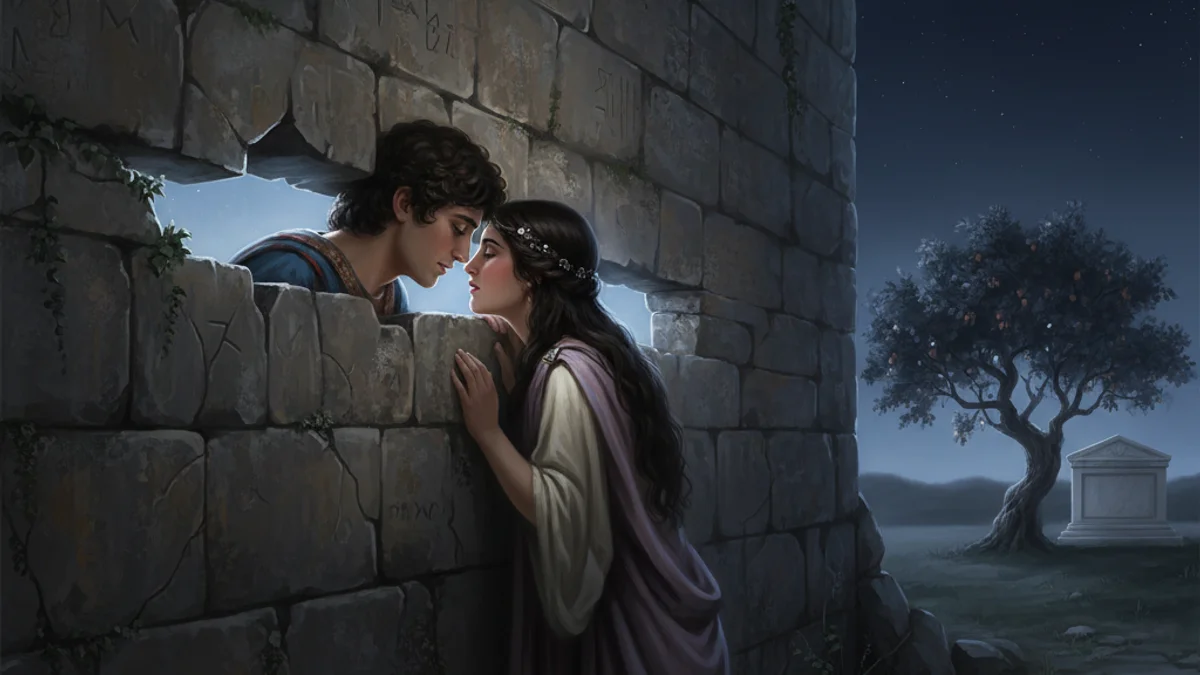
In the ancient city of Babylon, two youths named Pyramus and Thisbe lived in adjoining houses. Though their families were locked in a bitter feud, the two fell deeply in love. Forbidden from meeting, they discovered a small crack in the stone wall that separated their homes, through which they whispered their devotion. Driven by longing, they arranged a secret midnight tryst at the Tomb of Ninus, beneath a tall mulberry tree bearing white fruit. Thisbe arrived first, but was startled by a lioness with a blood-stained maw from a recent kill. She fled, dropping her veil, which the beast shredded and bloodied. When Pyramus arrived and saw the bloody veil and tracks, he assumed Thisbe was dead. Devastated, he plunged his sword into his side. Thisbe returned to find him dying; in her grief, she took his blade and followed him into the afterlife. Their blood stained the white mulberries dark red, a permanent memorial to their tragic, eternal bond.
The Moral
The haste of passion and the weight of misunderstanding can turn a hopeful heart into a tragic end.
“Love is a thing that will find its way through any obstacle, even a wall of stone.”
Fun Fact
In Ovid's version, the story serves as a 'metamorphosis' myth, explaining the biological transition of the mulberry fruit from white to deep purple.
Frequently Asked Questions
What is the origin of the story of Pyramus and Thisbe?
The most famous version of this legend is found in Ovid's 'Metamorphoses,' written around 8 AD, though it likely stems from even older Anatolian or Babylonian folklore.
How did Pyramus and Thisbe communicate?
They were forbidden from seeing each other by their feuding parents, so they whispered through a slender crack in the shared wall that divided their two houses.
Did Pyramus and Thisbe inspire Romeo and Juliet?
Yes, William Shakespeare used the plot of Pyramus and Thisbe as a primary source for 'Romeo and Juliet,' as well as including a comedic version of it in 'A Midsummer Night's Dream.'
Why did the mulberry tree change color in the story?
According to the myth, the berries were originally white, but they turned dark red after being stained by the blood of the two lovers, serving as a lasting symbol of their tragedy.
Where does the story of Pyramus and Thisbe take place?
The legend is set in the ancient city of Babylon, specifically at the Tomb of Ninus, which was located outside the city walls.
What caused the tragic ending for the two lovers?
A misunderstanding occurred when Pyramus found Thisbe’s bloodied veil and assumed a lion had killed her, leading him to take his own life, which prompted Thisbe to do the same.