Story Summary
Discover The Mice That Ate Iron, a classic Panchatantra tale where a clever merchant uses a hawk and a missing boy to expose his friend's greedy, iron-clad lie.
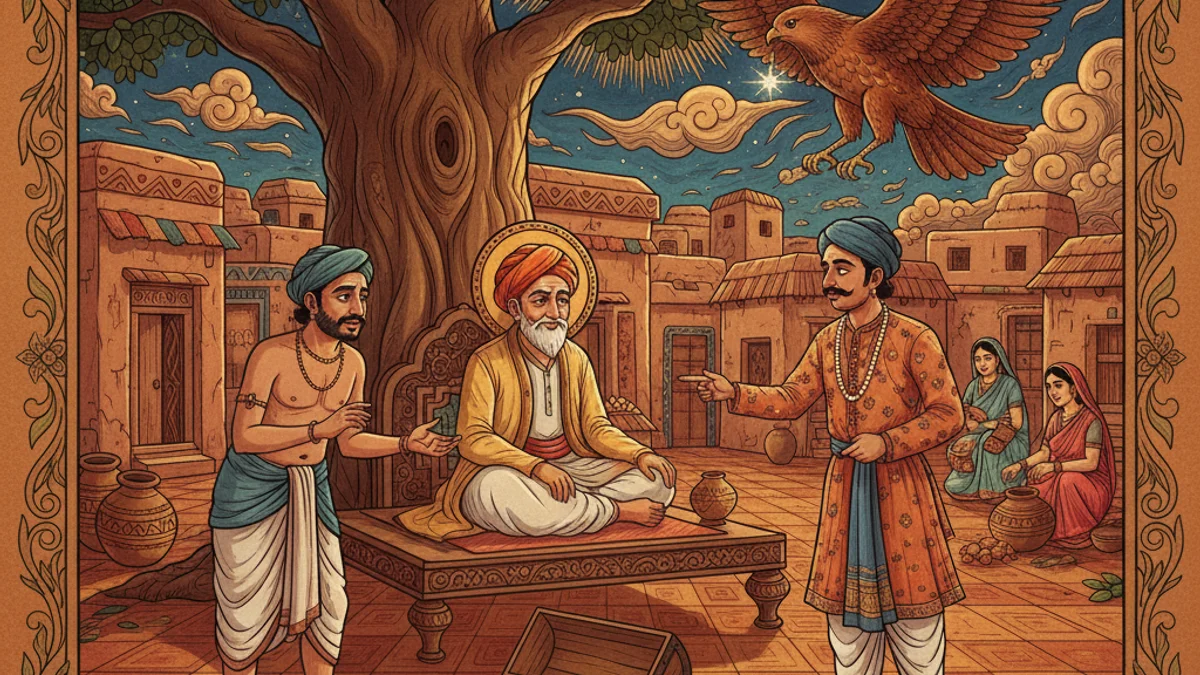
Naduka, a merchant who had lost his fortune, decided to travel abroad to seek new wealth. Before leaving, he entrusted his heavy iron balance—a family heirloom—to his friend Lakshmana. Years later, Naduka returned and asked for his balance. Lakshmana, hoping to keep the valuable iron, lied: "I am sorry, but the mice in my storehouse have eaten it." Naduka calmly replied, "If the mice ate it, it is not your fault." He then asked Lakshmana to send his son to the river to help carry some gifts. Once at the river, Naduka hid the boy in a nearby cave. When Lakshmana asked where his son was, Naduka replied, "A hawk flew down and carried him away." Furious, Lakshmana dragged Naduka to court, shouting that a hawk could never carry a boy. Naduka smiled and told the judge, "If mice can eat a heavy iron balance, surely a hawk can carry off a child." Realizing his folly, Lakshmana confessed. He returned the balance, and Naduka returned the boy.
The Moral
When dealing with a liar, one must use their own logic against them to reveal the truth.
“If mice can eat an iron balance, surely a hawk can carry away a child.”
Fun Fact
The Panchatantra, which contains this story, was translated into over 50 languages by 1600 CE, making it one of the most widely traveled secular texts in history.
Frequently Asked Questions
What is the moral of The Mice That Ate Iron?
The story teaches the concept of 'tit for tat' or using a person's own faulty logic to expose their dishonesty. It shows that deception can be countered by presenting an equally absurd scenario.
Who wrote The Mice That Ate Iron?
This story is part of the Panchatantra, an ancient Indian collection of Sanskrit animal fables. It is traditionally attributed to the scholar Vishnu Sharma as a tool for teaching political and life lessons.
Is it possible for mice to eat iron?
No, it is physically impossible for mice to consume a heavy iron balance. This biological absurdity is the central lie used by the greedy friend to steal from the merchant.
Why did Naduka hide the boy?
Naduka hid the boy to create a situation just as unbelievable as the one his friend claimed. By asserting a hawk took the boy, he forced his friend to admit that some claims are impossible.
What does the iron balance symbolize?
The iron balance represents Naduka’s ancestral wealth and the trust he placed in his friend. Its supposed loss signifies a deep betrayal of friendship and the corrupting nature of greed.
How does the judge resolve the conflict?
The judge recognizes the merchant's cleverness and the friend's obvious lie. He facilitates a resolution where both the stolen balance and the 'kidnapped' boy are returned to their rightful places.