Story Summary
Discover how Guru Gobind Singh Creates the Khalsa during Vaisakhi 1699, establishing a legacy of courage, equality, and the Five Ks in this powerful Sikh Saakhi.
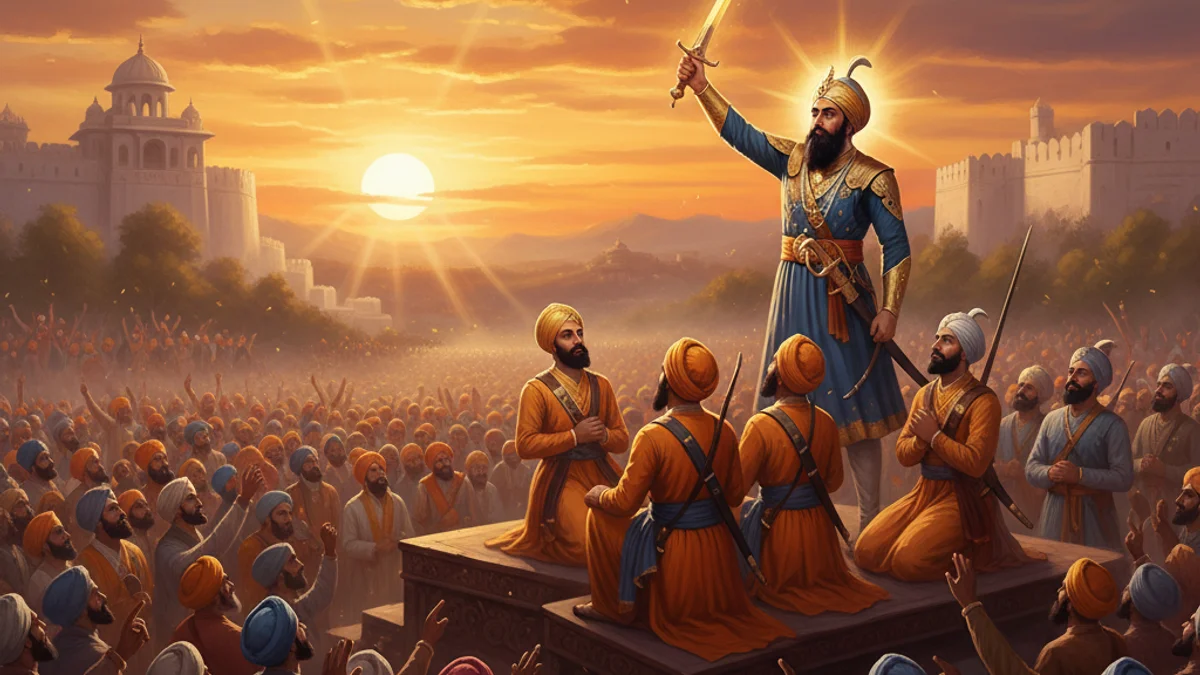
In 1699, on the day of Vaisakhi, Guru Gobind Singh Ji gathered a massive congregation at Anandpur Sahib. Standing before the crowd with a shimmering sword, he made a startling demand: 'Is there any true Sikh who is prepared to give his head for the Guru?' The crowd fell silent. Eventually, Daya Ram stepped forward. The Guru took him into a tent and returned with a blood-stained sword, asking for another head. Four more brave souls—Dharam Das, Himmat Rai, Mohkam Chand, and Sahib Chand—volunteered. Each time, the Guru emerged with a bloody sword. Finally, the Guru brought all five out, dressed in beautiful new garments and glowing with spirit. They were the Panj Pyare, the Five Beloved Ones. The Guru then prepared Amrit (holy nectar) in a steel bowl, stirred with a double-edged sword while reciting prayers. He initiated them into the Khalsa Panth, giving them the name 'Singh' (Lion) and mandating the Five Ks. In a final act of supreme humility, the Guru knelt before them and asked to be initiated himself, declaring that the Khalsa and the Guru were one and the same.
The Moral
True faith requires total surrender and courage, and true leadership is rooted in the equality of the teacher and the disciple.
“Waho Waho Gobind Singh, Aapay Gur Chela.”
Fun Fact
After the initiation, the Guru changed his own name from Gobind Rai to Gobind Singh, symbolizing his transition into the Khalsa brotherhood.
Frequently Asked Questions
What is the moral of Guru Gobind Singh Creates the Khalsa?
The moral is that true devotion requires the willingness to sacrifice one's ego and life for the sake of righteousness. It also teaches the principle of absolute equality among all human beings.
When was the Khalsa Panth created?
The Khalsa Panth was created on the day of Vaisakhi in the year 1699. This took place at Anandpur Sahib in Punjab, India.
Who were the Panj Pyare?
The Panj Pyare were the first five Sikhs to answer the Guru's call: Daya Ram, Dharam Das, Himmat Rai, Mohkam Chand, and Sahib Chand. They came from different castes and corners of India, representing unity.
What are the 5 Ks established during this event?
The 5 Ks are Kesh (unshorn hair), Kangha (wooden comb), Kara (iron bracelet), Kachera (cotton undergarments), and Kirpan (ceremonial sword). They serve as the uniform and identity of a Khalsa Sikh.
Why did the Guru ask for five heads?
The Guru asked for heads to test the fearlessness and commitment of his followers. He wanted to forge a community of 'Saint-Soldiers' who would never waver in the face of tyranny.
Why did the Guru ask the Panj Pyare to initiate him?
By asking for initiation, the Guru established the concept of 'Aape Gur Chela,' meaning the Guru is the disciple and the disciple is the Guru. This eliminated any hierarchy between the leader and the community.
Discussion (0)
Share your thoughts on this story
No comments yet. Be the first to share your thoughts!